Book Categories:

1. Why Perfume Bottle Size Matters

In the development of a perfume product, the choice of perfume bottle sizes is not merely a matter of capacity—the neck finish specifications and neck sizes are equally critical details that should not be overlooked.
Capacity determines the base quantity of raw materials required; bottle dimensions influence printing, outer packaging, and shipping costs; and the neck finish directly affects the selection and procurement cost of accessories such as pumps and caps. These factors are interdependent, and ultimately not only reflect in the total procurement cost but also manifest in the product’s retail price, indirectly shaping the consumer’s perception of the product’s value.
Understanding perfume bottle sizes is not just about gathering data for procurement—it is about planning ahead for the consumer experience that the product will ultimately deliver.
To make the sourcing decision more robust and comprehensive, this article will start from the core specification parameters of perfume bottle sizes, review the common dimensions and capacity configurations available on the market, and provide practical selection references based on different usage scenarios—helping procurement professionals find a relatively balanced position between product design, cost control, and market appeal.
2. Key Parameters of Perfume Bottle Sizes
Before diving into the specifications and dimensions of perfume bottles, we believe it is necessary to first provide an overview of three key parameters involved in perfume bottle selection—neck finish specification, capacity specification, and printing/decoration specification.
These three are independent of one another, yet together they determine the overall feasibility of the packaging solution. Understanding their basic logic will help you communicate with suppliers more confidently and with greater clarity.
2.1 Perfume Bottle Neck Finish


Currently, glass perfume bottles on the market are available in two main neck finish types: screw-thread and snap-on (or crimp) finishes. The table above summarizes the common specifications for both types, along with their corresponding capacity ranges.
It is worth noting that the relationships between these neck finish specifications and capacity ranges reflect general industry patterns, rather than absolute standards. Below, we will compare the basic considerations for each type when making a selection.

Screw-thread perfume bottles follow the standard system established by GPI, with multiple specification categories derived from variations in thread design—such as 400, 410, 415, and other thread classifications.
The main advantage of the screw-thread structure is that the spray pump can be freely removed and reattached without affecting the bottle’s secondary use. Whether the consumer keeps the bottle for other purposes after use, or the brand offers refill services, the screw-thread design provides greater operational flexibility.
It is worth noting that many people tend to believe that snap-on perfume bottles offer better sealing performance than screw-thread ones. In reality, however, the sealing performance of any perfume bottle—regardless of material—depends primarily on the fit between the pump and the neck finish, as well as the material of the pump gasket. Generally speaking, silicone gaskets offer superior sealing compared to the more common PE gaskets.
Compared to screw-thread bottles, snap-on perfume bottles provide a clear “click-in-place” feedback, which helps avoid uneven tightening or incomplete pump seating during high-speed filling lines. This is likely the main reason why many perceive snap-on bottles as offering better sealing integrity.
However, once a snap-on bottle is assembled, disassembly is relatively difficult. Repeated removal and reattachment may cause wear to the snap-fit, compromising sealing performance—or even leading to cracks in the neck finish. Therefore, snap-on bottles are better suited for single-use filling scenarios where the end consumer does not need to disassemble the pump.
When selecting between screw-thread and snap-on finishes, the choice is not a matter of technical superiority, but rather depends on product positioning and production conditions: if consumers need to be able to open or replace components themselves, screw-thread is the more reliable option; if the priority is high-speed filling and assembly efficiency, with no need for consumer disassembly during use, snap-on is the more appropriate match.
2.2 Perfume Bottle Body Dimensions

Understanding the neck finish classification and specifications of perfume bottles helps you make more informed choices when selecting pumps and caps. Likewise, understanding the bottle body dimensions gives you greater confidence in surface design and outer packaging procurement.
There are two critical parameters that procurement professionals and designers need to master when it comes to perfume bottle body dimensions: the printing area specifications and the outer packaging fit specifications. The former determines the placement and proportion of brand identity, product information, and other content on the bottle surface; the latter relates to the outer packaging design and costs.
The forming processes and design variations of glass bottles are extremely diverse, particularly for irregular-shaped bottles, which often feature non-uniform textures, sharp angles, and curved surfaces. Even with physical samples in hand, it can be difficult to obtain precise measurements using conventional tools. Therefore, when preparing for printing and outer packaging design, we recommend prioritizing the acquisition of standard drawings or printing die-lines from the supplier, and using these as the baseline reference for subsequent design work.
Obtaining these bottle body parameters in advance can significantly reduce rework losses caused by discrepancies between the design files and the physical product, while also enabling more efficient finalization of the packaging and shipping plan.
2.3 Perfume Bottle Capacity Specifications
Having understood the importance of the two parameters discussed above, now is the time to carefully consider which capacity best suits your product launch plan. The capacity of a perfume bottle not only affects raw material costs and product pricing, but also directly shapes the consumer’s first impression of the product’s positioning.
For ease of reference, we have divided the common perfume bottle capacities on the market into four ranges: mini size (0.5–5ml), sample/travel size (5–25ml), standard full-size (30–100ml), and collector’s large size (100ml and above).
Each range corresponds to different product positioning and usage scenarios. We will also share the key design and procurement considerations for perfume bottles within each range, to help you better filter the most suitable capacity for your product.
2.3.1 Mini Perfume Bottles: 0.5ml – 5ml

Perfume bottles in this capacity range typically appear as samples or promotional gifts. For brands, the main value of mini perfume bottles lies in lowering the consumer’s trial barrier—a 15ml perfume might give a consumer pause, but a 0.5ml–5ml sample is much easier to accept, and can serve as a gateway to future repeat purchases.
On the market, the design options for mini glass perfume bottles are relatively limited, with most featuring simple cylindrical bodies. However, the bottles can be paired with a variety of accessories to suit different application scenarios—such as roll-on balls, spray pumps, inner plugs, or stopper-style caps.
It is worth noting that most extremely small glass bottles do not feature standard screw-thread neck finishes, but instead use snap-on or crimp designs. However, if you require screw-thread mini perfume bottles, we do offer screw-thread options in our 1ml–10ml capacity range.
One practical consideration: the neck finish diameter of mini perfume bottles is relatively small, so more precise filling equipment is required during the production process. In addition, due to their compact size, mini bottles can easily be overlooked or misplaced in a bag. As such, they are better suited for fixed settings—such as perfume counters, blind-box sets, gift box inclusions, or home use—rather than on-the-go scenarios.
2.3.2 Small Size Perfume Bottles: 10ml-25ml

Small perfume bottles in the 10ml–25ml range typically play one of two important roles within a product line: entry-level full-size and portable on-the-go experience.
Compared to the brief sampling experience offered by mini sizes, small-capacity perfume bottles allow consumers to enjoy a longer-lasting fragrance experience, giving them more time to become familiar with and appreciate the scent profile of the product. Additionally, their slightly larger size makes them less likely to be misplaced compared to mini bottles, making them well-suited for daily commutes, travel, or on-the-go touch-ups.
Whether in glass or plastic, small-capacity perfume bottles offer greater design flexibility than mini sizes, with a wider variety of styles available. Naturally, the surface customization potential for the bottle body is also more extensive compared to mini bottles.
2.3.3 Standard Full Size: 30ml – 100ml

The 30ml–100ml range is the core specification segment for the vast majority of perfume brands—particularly those using glass perfume bottles as their primary packaging—and is also the capacity range most familiar to consumers, capturing the largest share of market sales.
In terms of product positioning, 30ml and 50ml typically target consumers seeking a refined experience or those who enjoy changing scents frequently, while 75ml and 100ml emphasize “better value per milliliter,” appealing to loyal users who use the fragrance on a regular basis. These two consumer groups may differ in purchasing motivation, but from a packaging design and production standpoint, bottles within the same series often only require adjustments to the bottle height to achieve capacity variations. This allows for consistent visual proportions across the line, while also ensuring good component compatibility.
Unlike the portability and trial-oriented nature of small-capacity perfume bottles, the full-size bottle represents a consumer’s genuine endorsement of the product. When a consumer buys a small capacity, they are still evaluating whether the fragrance suits them—the usage process itself is an ongoing assessment. When they return to purchase the full-size version of the same scent, they are not simply buying more product—they are making a confirmation: a confirmation of the value they are willing to invest, and a confirmation of the brand’s worth.
2.3.4 Collector’s Large Size: 100ml – 1L

For perfume products that use glass as their primary packaging medium, bottles exceeding 100ml are most commonly found in limited editions, holiday gift sets, or brand commemorative releases. The choice of this capacity has typically moved beyond the realm of “practicality”—its value lies not in “being used up,” but in “being possessed,” carrying both display and collectible significance.
Compared to standard full-size bottles, collector’s large-capacity perfume bottles often feature more elaborate and intricate designs, with finer attention to craftsmanship details. When the capacity is generous enough and the material weight substantial enough, the bottle’s visual presence alone can rival that of the fragrance itself—even becoming a major component of the work. This also means that the scent itself is no longer the starting point of the design; the brand must instead consider how to convey the narrative, atmosphere, or brand spirit embodied by the fragrance—through the material, proportion, and surface craftsmanship of the bottle—in a physical form that carries equal weight.
Therefore, when planning a collector’s large-capacity perfume bottle, it is worth returning to the starting point of perfume bottle material selection—to explore the brand’s creative expression within this collectible format. Whether glass, crystal glass, ceramic, or metal, each material corresponds to a different texture, craftsmanship, and visual language—and ultimately determines how the piece will be seen and remembered.
It is worth noting, however, that for fast-consuming fragrance products with shorter longevity and lower fragrance oil concentration—such as body sprays—plastic bottles are far more commonly used. These products typically come in capacities of 150ml or more, and this volume is simply considered a standard full size rather than a collector’s or limited-edition offering. Therefore, perfume bottles over 100ml can carry different positioning depending on the application scenario and material used.
3. Key Factors to Consider When Choosing Perfume Bottle Sizes
The above sections cover the four capacity ranges for perfume bottles and their respective application characteristics. Through this overview, we believe you now have a basic framework for understanding the positioning of different capacities.
However, in actual procurement, the choice of capacity is rarely determined by “instinct” or “convention” alone—it requires a comprehensive evaluation that brings together multiple factors, including brand positioning, product usage scenarios and frequency, and cost structure.
To this end, we have distilled the selection logic scattered across the previous sections into a more cohesive decision-making framework—to help you arrive at a more well-rounded judgment before making a final decision.
3.1 Product Positioning

If a fragrance is the brand’s flagship core product, intended to be sold consistently over a longer lifecycle, then standard full-size capacities (50ml, 100ml) are the most reliable choice—ideally complemented by a 10ml travel size to accommodate on-the-go usage scenarios.
For seasonal limited editions or collaboration launches, a moderate capacity of 15ml–30ml can help lower the consumer’s decision barrier, while refined packaging details convey a sense of exclusivity.
For special editions targeting the collector’s market, capacities of 200ml or more are often preferred—the visual presence of a larger volume helps match the collectible value of the release.
3.2 Fragrance Usage Frequency and Application Scenarios
The concentration and longevity of a fragrance directly influence consumer usage frequency and application scenarios. Therefore, when selecting perfume bottle capacity, it is essential for brands to have a clear understanding of their fragrance’s concentration and lasting power—in order to accurately interpret how the product will be used, and offer consumers a capacity choice that makes sense for their needs.
Fragrances are generally classified into five categories based on fragrance oil concentration, each with varying longevity and corresponding usage habits and capacity preferences.

Eau Fraiche (EF)
EF typically contains 1%–3% fragrance oil and lasts less than one hour—making it the lightest category of fragrance. Common examples include aftershaves and body sprays. These products prioritize instant freshness over longevity, and are often used casually—typically after a shower or post-workout. As such, capacity options are relatively broad, with packaging commonly starting at 100ml or more, and spray formats are preferred to facilitate application over larger areas.

Eau De Cologne (EDC)
EDC typically contains 2%–4% fragrance oil and lasts approximately two hours. Colognes often feature citrus and herbaceous notes, offering a refreshing and uplifting effect. Traditionally used after bathing or in hot weather, they belong to the daily refreshment category.
Due to their shorter longevity and higher usage volume, mainstream cologne capacities are typically concentrated in the 100ml–200ml range. For products primarily intended for post-bath home use, capacities of 300ml or above are also a reasonable option, helping to reduce repurchase frequency and encourage consistent usage habits.

Eau De Toilette (EDT)
EDT contains approximately 5%–15% fragrance oil and lasts about 3–4 hours. As the most widely encountered fragrance type for entry-level consumers, EDT offers a smooth and gentle scent profile, making it suitable for daily commutes and office environments. Standard full-size glass bottles typically range from 30ml to 100ml. Given the need for daytime touch-ups, brands often complement these with 5ml–10ml travel sizes, enhancing all-day usability.

Eau De Parfum (EDP)
EDP contains approximately 15%–20% fragrance oil and lasts about 4–5 hours. Offering longevity closest to pure perfume, EDP strikes a balance between quality and value—making it the most common concentration in high-end and mainstream fragrance lines. These perfumes are typically presented in 30ml or 50ml glass bottles, as the combination of sophistication and practicality tends to favor a small-to-medium capacity structure, with larger sizes playing a supporting role.

Perfume (P)
Perfume contains approximately 20%–40% fragrance oil and lasts over 8 hours—offering the longest longevity and richest olfactory complexity among all fragrance types, with a correspondingly higher price point. Typically reserved for evening events or formal occasions, its high unit price and low per-use dosage mean that capacities are predominantly 30ml or below, emphasizing sophistication and collectible value.
3.3 Spray Output and Usage Cycle of Perfume

After understanding fragrance concentration classifications, another factor that should inform capacity decisions is the usage cycle of the perfume—i.e., how long a bottle will typically last under regular usage frequency.
By understanding the scenarios in which target consumers use the fragrance and their daily application frequency, brands can estimate how soon a bottle will be finished. This data helps you make more informed capacity choices that reflect actual market usage patterns, giving you greater confidence in selecting capacities and managing inventory.
To help you get a clearer picture of how long different perfume bottle sizes last under various usage frequencies, we have summarized the data in the table below. Please note that the number of sprays in the table is calculated based on a pump output of 0.1ml per spray. Different pump outputs will yield different results—currently, spray outputs on the market can range from 0.045ml to 0.25ml per spray. The actual usage cycle of the perfume should be recalculated based on the specific pump output you choose.
In addition, the number of uses also depends on the fragrance’s longevity and concentration, so the usage frequency provided below is an estimated range rather than an exact figure.
Admittedly, this table is not intended to precisely predict every consumer’s individual habits—actual usage duration will vary due to personal differences. Its real value lies in helping procurement professionals establish a clear mapping between capacity, usage, and duration—so that product planning decisions can be better aligned with market strategy.
For example, consider an EDT positioned for daily commuter use. If the target consumer falls into the moderate-frequency category, a 50ml bottle would last approximately six months. Whether this duration matches the brand’s intended repurchase rhythm is exactly the kind of question procurement can evaluate using the framework provided above.
3.4 Consumer Preferences

Above, we have examined perfume bottle specification selection logic from perspectives such as capacity and spray output. However, capacity choices ultimately need to serve market demand. Whether a product is taken home by a consumer at the right moment often depends not only on the bottle design, but also on certain consumer purchasing preferences.
To help procurement professionals gain clearer decision-making insights, we have selected three consumer research reports from the UK market, and analyzed them from three dimensions: trial pathways, purchase budget, and fragrance-switching motivations.
While the sample populations in these studies are predominantly UK-based female consumers, the behavioral patterns they reveal offer generally applicable reference value for most mature markets.
3.4.1 How do Consumers Discover New Perfumes?
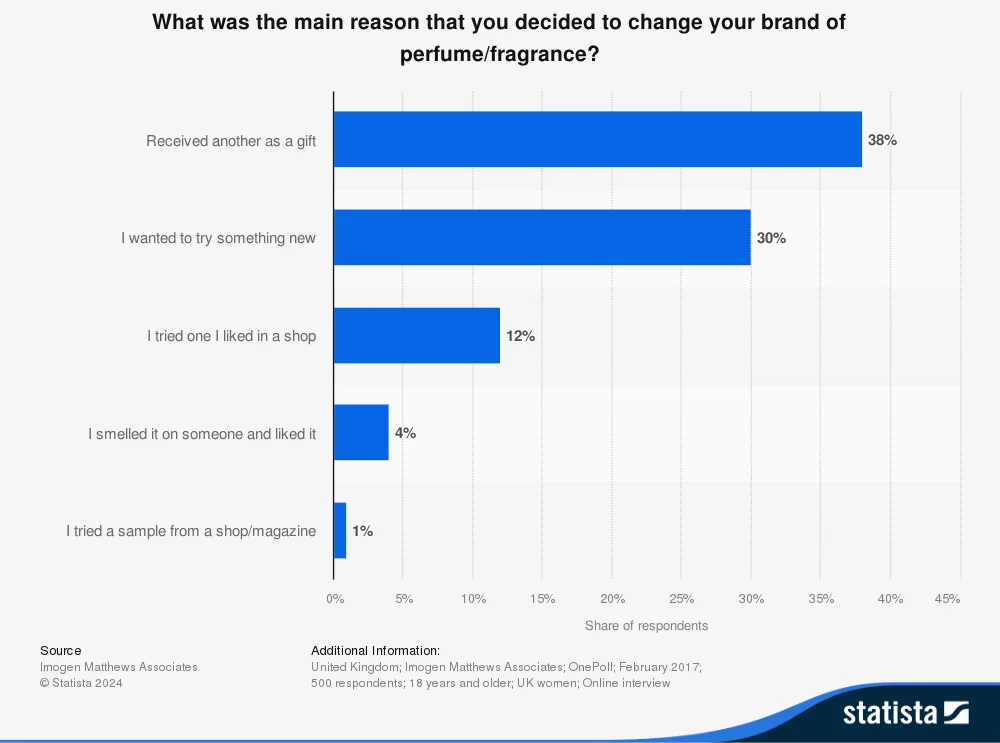
The above survey covers the motivations behind consumers switching perfume brands, which can also be understood as the primary channels and touchpoints through which consumers discover new fragrances. Several insights from the data are particularly worth highlighting:
- 38% switched brands after receiving a perfume as a gift;
- 30% switched because they actively wanted to try a new scent;
- 12% switched after discovering a fragrance they liked in-store;
- 1% switched as a result of sampling.
These findings offer valuable directional guidance for perfume product design and capacity selection. The data shows that the majority of consumers are introduced to new fragrances through gifting. This means that regardless of capacity, the outer packaging design deserves careful attention—presenting the product as a beautifully crafted gift can often be a powerful trigger for the purchaser’s buying decision.
In terms of capacity strategy, for brands with a diverse product portfolio, multi-product mini gift sets are a worthwhile option to consider. They help reduce the giver’s decision-making pressure, lower the recipient’s trial barrier, and support broader brand exposure—making it a strategy that benefits multiple parties.
The 1% figure is also worth noting. To some extent, it suggests that extremely small samples may, in certain contexts, struggle to convey the full olfactory complexity and user experience of the fragrance. Therefore, mini perfumes or small-capacity bottles deserve more thoughtful attention in terms of packaging design, display presentation, trial mechanisms, and sales strategy—considering how to leave a sufficiently strong impression within a limited product volume, so that the fragrance remains memorable even after the sample is used up.
3.4.2 How Much Are Consumers Willing to Pay for Perfume Gifts?
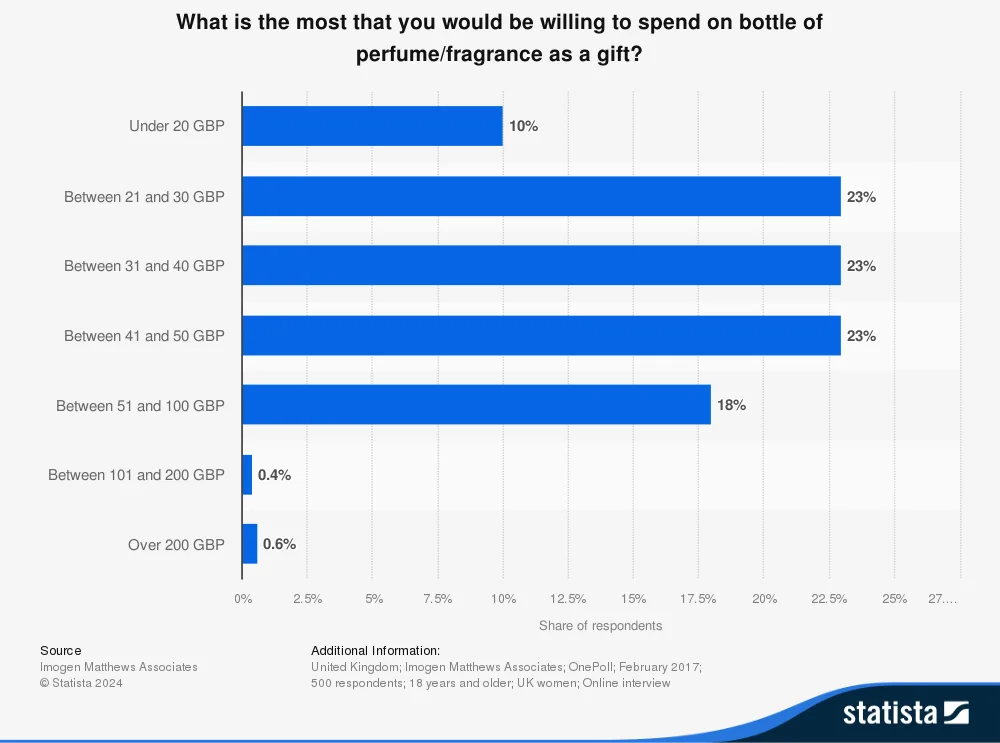
The above chart presents the price range consumers are willing to pay when purchasing perfume as a gift, which also indirectly reflects the general budget consumers allocate to perfumes for personal use. Several data points stand out:
- The £21–50 (approx. USD 28–68) range accounts for the highest share, totaling 69%;
- The £51–100 (approx. USD 69–136) range follows, at 18%;
- The £20 (approx. USD 27) and below range represents a smaller share of just 10%.
Consumer price expectations for perfume products are a critical reference that brands should not overlook when setting procurement budgets and determining capacity specifications.
If a product is priced at over £50 (approx. USD 70), the packaging quality and brand narrative need to provide sufficient value justification—meeting consumer expectations that price and quality are aligned.
If the pricing falls within the mainstream range of £20–50 (approx. USD 30–70), brands need to conduct a deeper competitive analysis and highlight distinctive features—whether in scent profile, packaging design, or usage experience—to gain an edge over similar products.
For products priced at £20 (approx. USD 30) or below, consumers tend to prioritize value for money. In this segment, packaging needs to be clean and functional—there is no need to pursue premium materials or elaborate finishing.
3.4.3 Data Usage Notes and Supplementary Recommendations

The above data is sourced from a UK market survey report published by Statista, with a sample collection period in 2017, covering 500 British women aged 18 and above. While the data is somewhat dated and geographically focused on the UK market, the consumer behavior patterns it reveals—such as the role of gifting in driving brand switching, the influence of price ranges on purchase intent, and the relationship between trial experience and capacity selection—remain broadly applicable and referential across most mature markets.
It should be noted, however, that consumption habits and price expectations vary across different markets. When applying the above data to your own product planning, we recommend making a comprehensive assessment based on the actual conditions of your target market. Additionally, for more up-to-date data, you may visit the Statista platform and search using keywords such as “perfume consumer behavior,” “fragrance gifting,” or “perfume price sensitivity” to access the latest industry reports and consumer research findings.
4. Sourcing Perfume Bottles
The selection of perfume bottle capacity may appear to be a simple matter of choosing a number, but in reality, it touches multiple dimensions—product positioning, cost structure, consumer experience, and market strategy. From fragrance concentration to usage frequency, from spray output to usage cycle, from consumer budget to gifting scenarios—each piece of data contributes to the final capacity decision. Brands that take these details seriously are often able to make more sound decisions during the product planning stage, leading to a smoother market performance after launch.
We hope the framework and data provided in this article can offer you clearer direction when selecting perfume bottle capacities. Whether you are developing an everyday EDT for commuters or a collector’s perfume for a niche audience, capacity selection deserves careful and thoughtful consideration.
As a supplier specializing in plastic and glass perfume bottle solutions, we have accumulated extensive practical experience in bottle style selection, specification confirmation, and packaging execution. If you still have questions about capacity choices after reading this article, or would like more specific recommendations, please feel free to reach out to us. From bottle style recommendations to accessory matching, from sample testing to mass production delivery—we are here to support you every step of the way.