Book Categories:

In packaging design, form is the most deceptive appearance. Take the plastic can as an example—its broad shoulder and wide-mouth design can easily be mistaken for a plastic cosmetic jar commonly used for skincare products. However, this is a “beautiful misunderstanding.” In fact, apart from a similar visual diameter, the two can differ significantly in structure, sealing method, and even material composition.
Today, through a side-by-side comparison between the Plastic Can and the Cosmetic Jar, we will break down the unique advantages of the former, offering you a new option for your wide-mouth container sourcing.
1. Plastic Can VS Plastic Cosmetic Jar

1.1 Neck Differences
At first glance, the Plastic Can bears a striking resemblance to the common cosmetic jars found on the market—both appear to be wide-mouth containers. However, the most apparent difference lies in the closure: the former typically features aluminum pull-tab lids or regular ring pull-tab lids, whereas the latter is usually paired with a screw cap and a sealing disc. This distinction is not merely a matter of brand preference; it is fundamentally rooted in the different neck finish structures of the two container types.
As shown in the comparison picture above, the Plastic Can adopts an outward-curled neck finish at the rim. This design is specifically developed to interlock with pull-tab lids, enabling reliable sealing performance. In contrast, the standard wide-mouth jar on the right employs a CT (continuous thread) finish, which allows for direct screw-cap application or the use of a sealing disc beneath a screw cap.
It is worth noting that the outward-curled neck finish of the Plastic Can does bear some visual similarity to certain cosmetic inner bottles (inner liners). However, the functional logic is entirely different: the outward curl on a cosmetic inner bottle is designed to tightly engage with an outer shell, while that on the Plastic Can is intended to accommodate various pull-tab lid options.
A special note: there are indeed Plastic Can variants available on the market with external threads. These can be paired with a pull-tab lid and additionally fitted with an outer screw cap for secondary coverage. However, the screw cap in such cases serves only as an auxiliary decorative or dust-proof overlay—it cannot function as the primary seal on its own. Otherwise, the screw cap would not thread on properly, and sealing integrity would be completely compromised.
1.2 Application Differences
In our article “8 popular Types of Preforms,” we previously mentioned that the neck finish configuration often directly indicates the intended application field of a plastic container. Taking the Plastic Can as an example, its outward-curled neck finish is predominantly used in food and beverage packaging—ranging from dry snacks such as nuts, coffee beans, and biscuits, to liquid beverages including juices, milk teas, and carbonated soft drinks.
The conventional CT (continuous thread) wide-mouth jar, on the other hand, enjoys broader applicability, spanning both the food and cosmetic sectors. However, when standard CT-threaded wide-mouth jars are used for food canning, they typically require an additional aluminum foil induction seal or HIS liner beneath the screw cap to achieve the desired hermetic sealing performance.

That said, the above represents a general industry pattern rather than an absolute rule. In practice, the Plastic Can is quite versatile in its applications. In recent years, particularly within the personal care sector, many brands have favored wide-mouth Plastic Cans for products such as body scrubs and bath salts. Behind this trend lies an intriguing consumer psychology: skincare products are subtly appropriating the visual language of food packaging.
When you open a container that resembles a food jar and scoop out a scrub infused with fruity or cereal-like granules, the delicate ambiguity between “edible” and “non-edible” adds a refreshing layer of sensory novelty to daily skincare routines. This visual contrast has become a clever strategy adopted by many emerging brands to convey the concept of “joyful skincare.”

One critical note: if a Plastic Can is to be used for carbonated beverages, the base design must be carefully engineered. Due to the significant internal pressure generated after filling and sealing carbonated drinks, a conventional flat bottom is insufficient to withstand uneven stress distribution. Therefore, the bottom is typically designed with star-shaped or petal-shaped indentations. These geometric structures help disperse the internal pressure-induced tension across the container body, effectively preventing deformation or rupture.
1.3 Sealing Method Differences
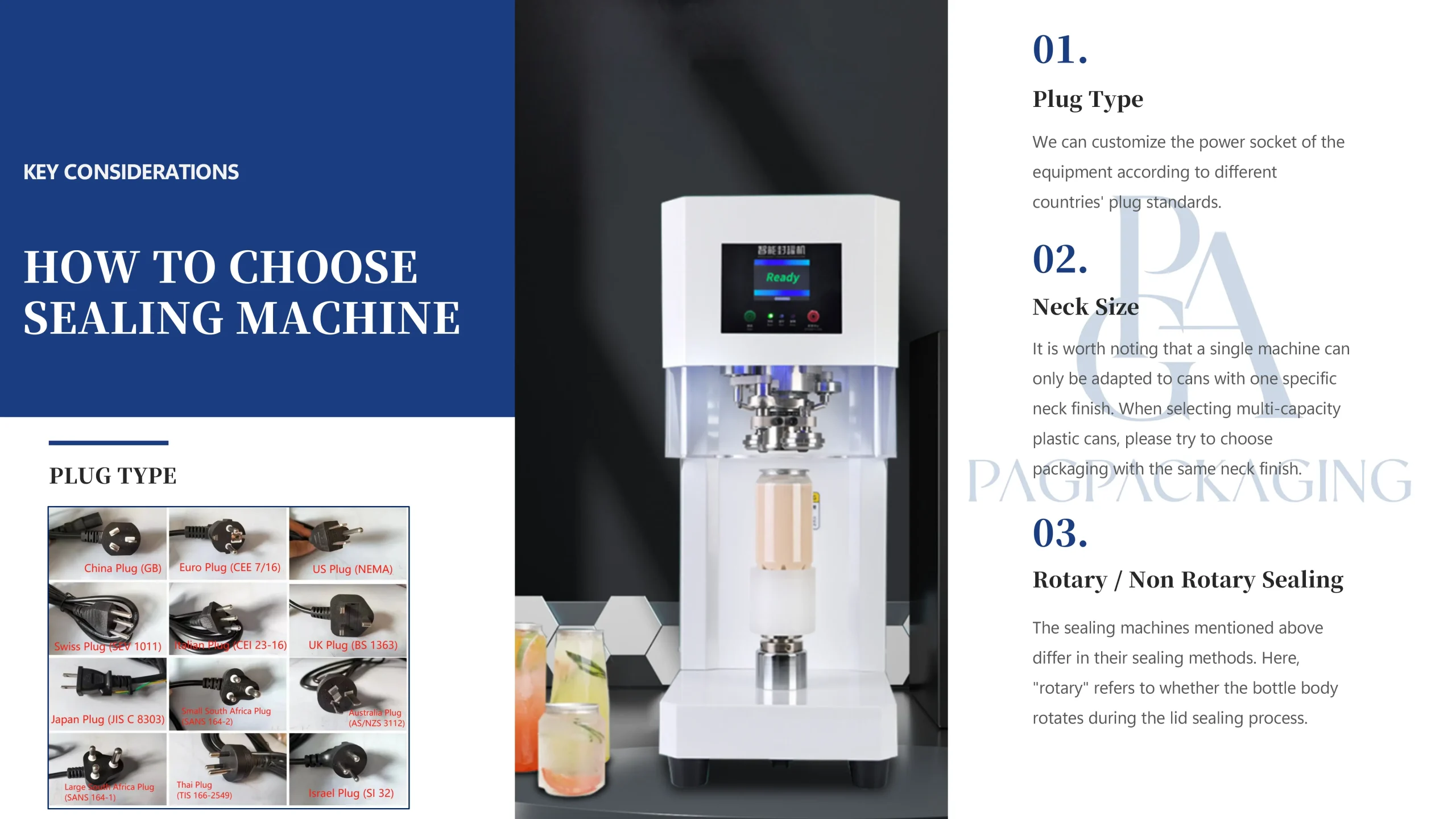
The differences in sealing accessories directly determine the sealing equipment and process pathways for plastic containers. For conventional wide-mouth jars, sealing typically only requires a capping machine or manual screw-capping on the production line. Plastic Cans, however, rely on dedicated sealing machines—representing a fundamental distinction in equipment selection between the two.
The image above shows a semi-automatic sealing machine suitable for small-batch production. For high-volume Plastic Can sealing requirements, mature automated production line equipment is also readily available on the market.
A critical note when selecting such small-batch sealing machines: close attention must be paid to the compatibility of power supply specifications and neck finish accessory models. Additionally, a single sealing machine generally accommodates only one neck finish size. If production involves Plastic Cans of multiple diameters, it is advisable to equip dedicated machines for each specification—frequent changeovers of sealing accessories are not only highly cumbersome to operate, but repeated
2. Plastic Can Solution

We believe that the analysis above has offered you a deeper understanding of “wide-mouth containers” beyond mere appearance—from neck finish structures to sealing methods, from application scenarios to equipment compatibility, every aspect carries its own considerations in container selection.
As a manufacturer with over a decade of expertise in the plastic packaging industry, we have consistently kept a close eye on the innovation and evolution of packaging forms. The Plastic Can is one of our newly developed product lines, strategically positioned based on our market trend insights. Whether you are in the food, beverage, or personal care sector, we are well-equipped to provide end-to-end support—from container development to sealing process solutions—tailored to your product characteristics and cost expectations.
We welcome you to request our exclusive mold catalog and look forward to collaborating with you to explore the market potential of this packaging format.