Book Categories:

Of all the surface finishing techniques for bottles, silk screen printing remains the most technologically mature and widely adopted in the packaging industry.
However, with the continuous advancement of packaging technology, printing processes for bottles have also diversified. You may often come across terms online like UV printing, pad printing, and more—seemingly all capable of decorating bottle surfaces. Yet, few clearly understand the distinctions between them or the key factors to consider when choosing a suitable technique.
Today, starting from its most common industry alias, we’ll guide you through the full process of silk screen printing—from its working steps and essential equipment to cost evaluation—taking you on a deep dive into the venerable art of silk screen printing—a surface finishing technique whose legacy stretches back over a thousand years.
1. What is Silk Screen Printing
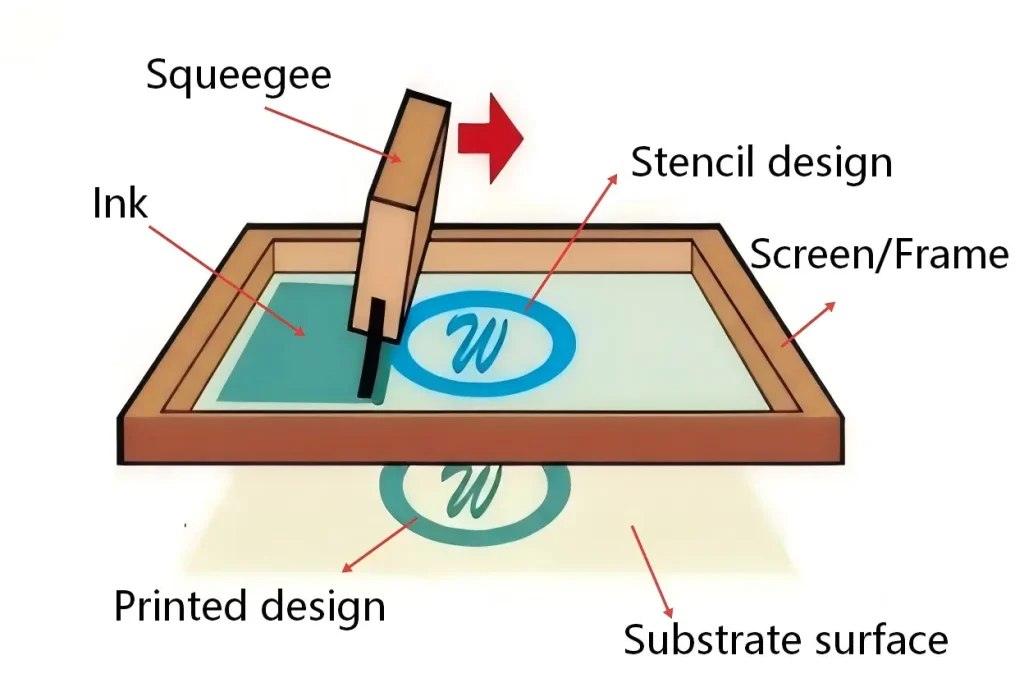
Silk screen printing, also known as screen printing, is a process that uses a screen with a stencil design to transfer ink onto a substrate by moving a squeegee back and forth. The principle is that ink passes through the open mesh areas of the screen, permeating the substrate surface to form graphics consistent with the original design. The screen with stencil design is the core component of silk screen printing technology, determining the shape and precision of the printed pattern.
While all are printing techniques, silk screen printing differs notably from pad printing, UV printing in terms of substrate compatibility, equipment, and process workflow. For example, pad printing involves pressing a silicone rubber pad onto an etched plate; the pad then picks up the ink from the plate and transfers it to the surface of the object.
2. How to Make a Stencil for Silk Screen Printing
Based on the principle of silk screen printing, you can understand that it is indeed a form of porous printing. However, you might find it hard to visualize the “open mesh areas of the screen,” since the typical screen we see doesn’t show obvious “holes.” Once you learn about the steps involved in making a screen, I think you’ll suddenly grasp the ingenuity behind this printing process.
The production of a stencil typically involves 5 steps, and there is quite a bit of detailed information involved. If you are not particularly interested in how the stencil for silk printing is formed, I would recommend skipping ahead to read the next section, “The case study of silk screen design”.
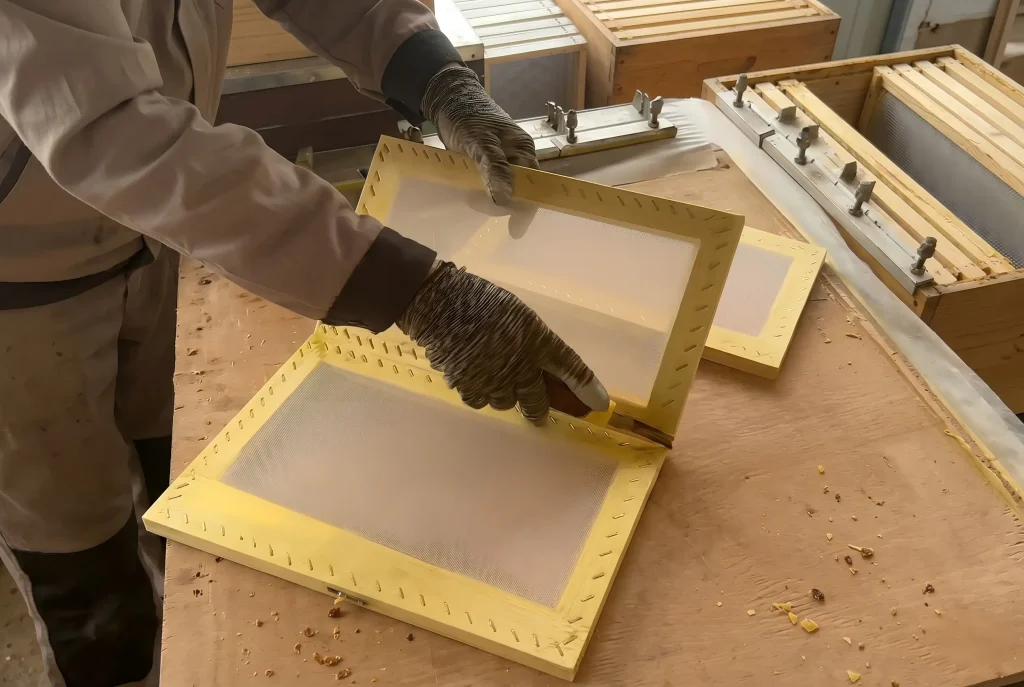
2.1 Fram Preparation
The craftsman selects a frame and silk mesh of appropriate size based on the dimensions of the design. Frames are commonly made of either wood or aluminum alloy. Aluminum alloy frames are more expensive than wooden ones but offer greater durability and lighter weight. Their low coefficient of thermal expansion also makes them less prone to deformation.
The choice of silk mesh depends on the design requirements (Mesh refers to the number of threads per inch in a silk screen). Silks come in various mesh counts, each corresponding to a specific range of aperture sizes. These aperture dimensions directly affect the precision and fineness of the printed pattern. The following section details the relationship between different silk screen aperture sizes and the corresponding printing outcomes.
| Mesh | Aperture sizes ( ) ) | Applications |
| 80 | 250-300 | Very Large Apertures: Suitable for bold, heavy-lined designs; |
| 120 | 150-180 | Large Apertures: Ideal for general graphics and thicker lines on the clothes. |
| 180 | 100-120 | Medium Apertures: Used for standard patterns and regular fine lines. |
| 230 | 80-100 | Small Apertures: For detailed text and intricate graphics; |
| 300 | 60-80 | Fine Apertures: High-precision printing requires very fine pigment particles with good fluidity. |
| 350 | 50-65 | Extra-Fine Apertures: Used for high-resolution graphics such as fine circuits and electrode materials; |
| 420 | 40-50 | Ultra-Fine Apertures: High-resolution electronic printing with extremely small apertures; paste must be strictly filtered. |
| 500 | 25-35 | Micro/Nano Apertures: Typically in advanced electronics or micro-printing; requires specialty inks and controlled environments. |
After selecting the frame and silk mesh, the craftsman secures the mesh to the frame using a staple gun. The screen is then rinsed with water to remove any dust or debris, ensuring that no contaminants interfere with the printing quality.
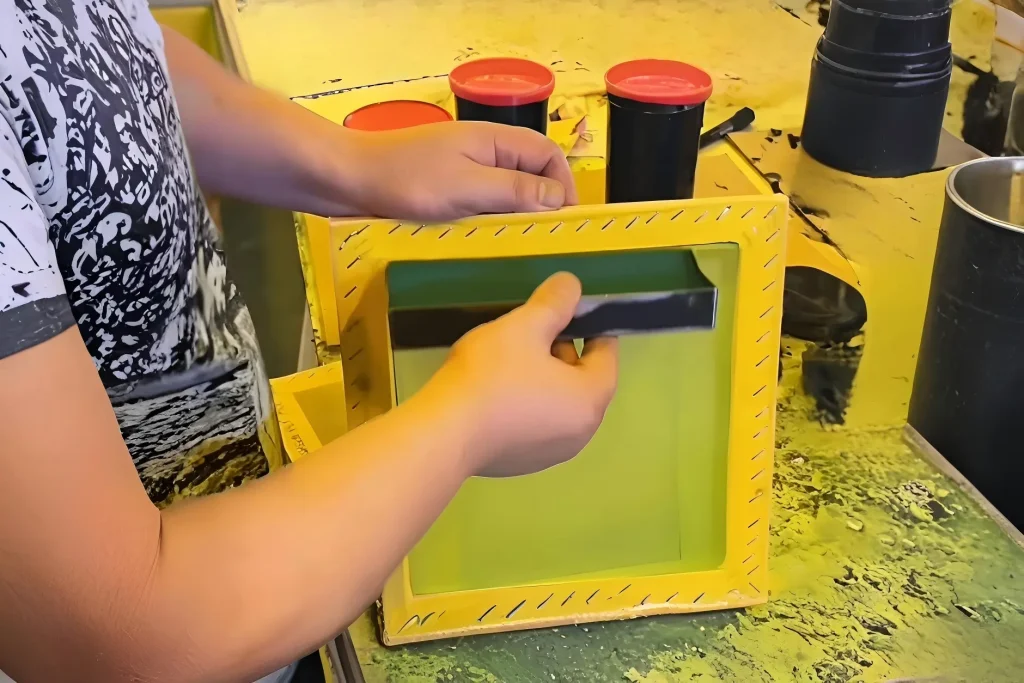
2.2 Apply Emulsion
Once the screen is dry, a photosensitive emulsion is applied to both sides. This emulsion hardens when exposed to UV light. Once cured, it blocks the mesh openings, preventing ink from passing through. After the emulsion is applied, the screen must be dried completely before proceeding to the next step
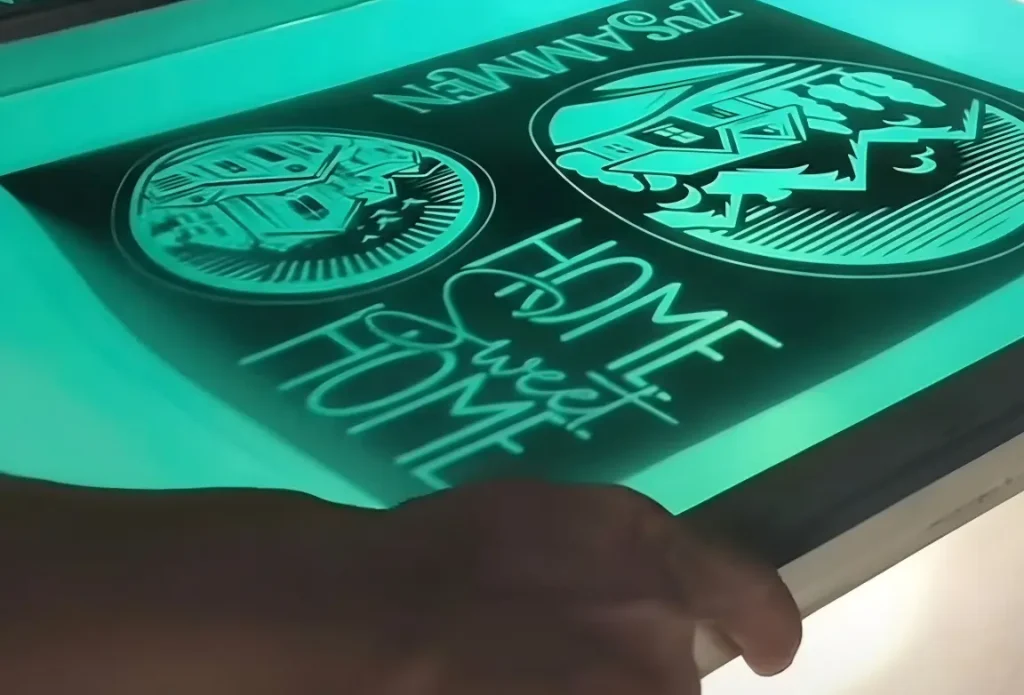
2.3 Attaching the Film Positive and Exposure
After the silk screen is dry, the prepared film positive is placed onto the screen. The assembly is then positioned in an exposure unit for processing. The film positive is typically produced from vectorized artwork. Therefore, when submitting final design files to your packaging supplier, ensure all text is converted to outlines (vectorized) so they can prepare the necessary printing materials for production.
During this stage, the photosensitive emulsion on the screen is cured by the UV light in the exposure unit. However, the areas shielded by the opaque black patterns on the film positive remain uncured and retain their solubility.

2.4 Wash out the Silk Screen
Rinsing the silk screen is the key step to creating the “open mesh areas of the screen”! Water is washed over the surface of the silk screen, dissolving and washing away any emulsion that was not cured. This completely “opens up” the mesh in those areas, leaving clean, open holes, while the surrounding emulsion—cured by the UV light—remains solid and blocks the mesh.
2.5 Drying and Sealing
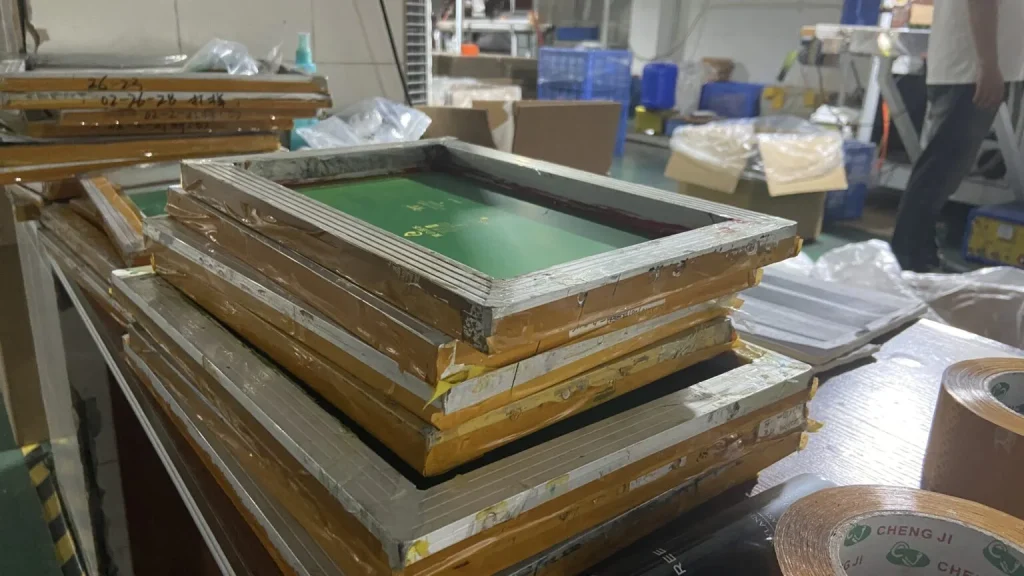
After rinsing, the silk screen must be dried again. The edges are then sealed with tape and adhesive. Once these steps are completed, the silk screen is ready for printing.
3. Case Study of Silk Screen Printing Design
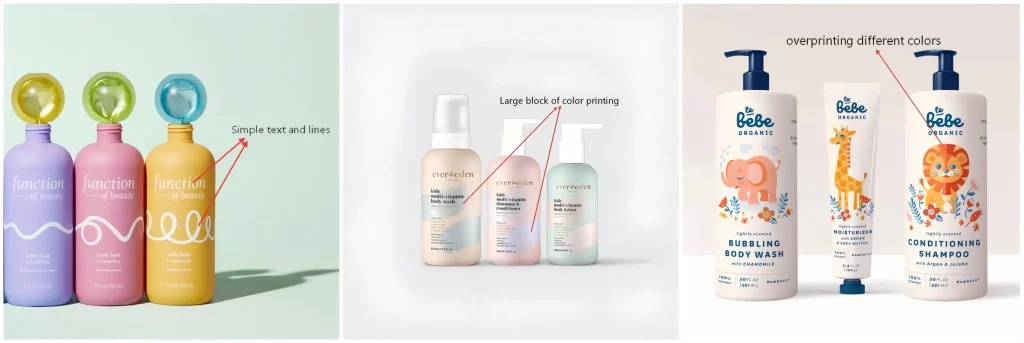
In the realm of printing techniques, silk screen printing stands out as a low-cost yet highly adaptable surface finishing process. It can be applied to flat, curved, and even spherical surfaces, and is compatible with a wide variety of substrate materials like Glass, PET, PE, etc.
Beyond simple text and lines, silk screen printing can also achieve large blocks of solid color as well as complex patterns formed by overprinting different colors. In our current projects for clients, the most common configuration involves printing graphics with up to 6 colors, including three-color overprint effects.
Although silk screen printing is highly adaptable and can be highly automated, its real-world production still heavily relies on the technician’s experience. Similarly, although silk screen printing supports multi-color registration printing, the alignment control during proofing and production places high demands on the operator. Inadequate experience can easily lead to color misalignment, require more materials for machine adjustment, and ultimately increase production costs.
4. Silk Screen Printing on Plastic Bottles
If you’re an outstanding packaging buyer or designer who has a strong thirst for knowledge, then you may want to learn some real stuff—like how does silk screen printing work.
When you understand what actually happens during the printing process, you’ll be more confident in your packaging designs, more aware of how each stage impacts quality, and better informed about what really affects production costs.
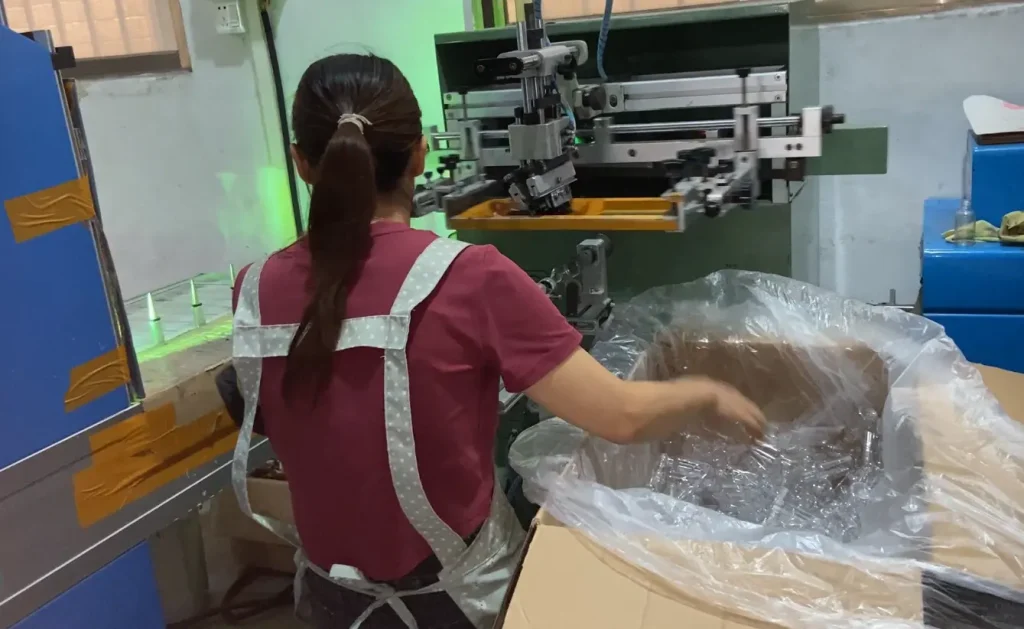
Currently, there are mainly fully automatic and semi-automatic silk screen printing machines for bottles. However, depending on the material being printed, the required auxiliary equipment and process steps differ.
If printing on plastic bottles with a semi-automatic silk screen printing equipment, you’ll need more than just the printer itself—you’ll likely also require a UV curing machine for bottles and a flame treatment system. For PE or PP bottles in particular, “flame treatment” is necessary before printing. This step actually improves print quality: the flame not only removes impurities and dust from the bottle surface but also slightly softens it, allowing the ink to adhere better and resist peeling.
After printing, bottles must be placed in a UV curing unit so the ink can harden quickly without delaying the next steps, like packaging.
Semi-automatic presses are generally used for small‑batch production or sampling, while fully automatic systems are employed for production runs of 5,000 units or more. Although the staffing needs for semi and fully automatic machines may not differ greatly, their output capacity and print consistency can vary significantly.
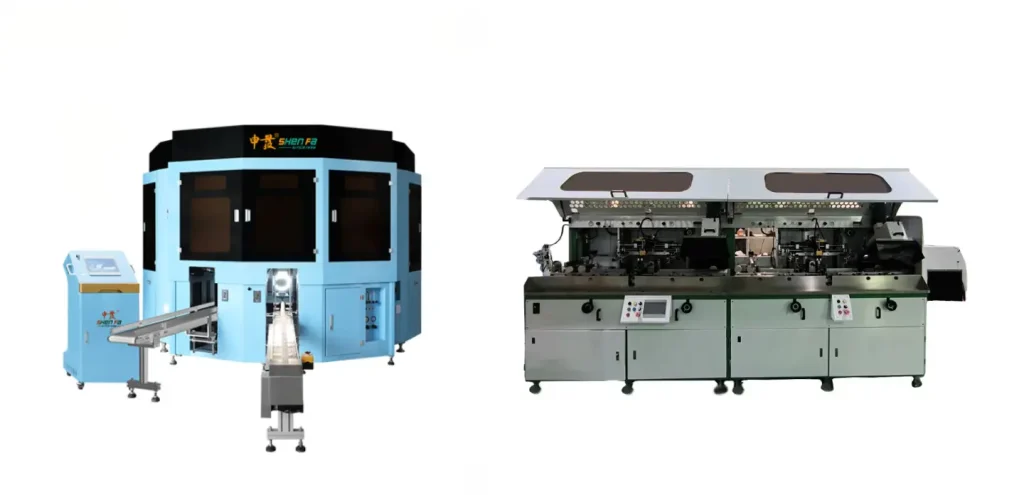
Fully automatic screen printing machines have undergone rapid iterative development in recent years, with significant improvements in both production capacity and equipment layout. Current fully automatic models integrate a complete series of processes—including automatic bottle feeding, flame treatment, printing, and drying—into one streamlined system.
Compared to semi-automatic machines, they not only optimize output and speed but also reduce defect rates. The image on the right shows a common parallel two-color screen printing machine, widely adopted by many factories. The image on the left depicts a higher-priced multi-color press capable of printing up to eight colors. Some all-in-one models can not only print multiple colors but also integrate processes such as hot stamping and screen printing.
5. Silk Screen Printing on Glass Bottles
The screen printing process and equipment used for glass bottles are generally similar to those for plastic. However, the investment in machinery and labor tends to be higher for glass.
Glass bottles are heavier than plastic ones, so certain components in automated machines differ from those designed for plastic bottle printing. Additionally, the ink properties used for glass differ from those for plastic.
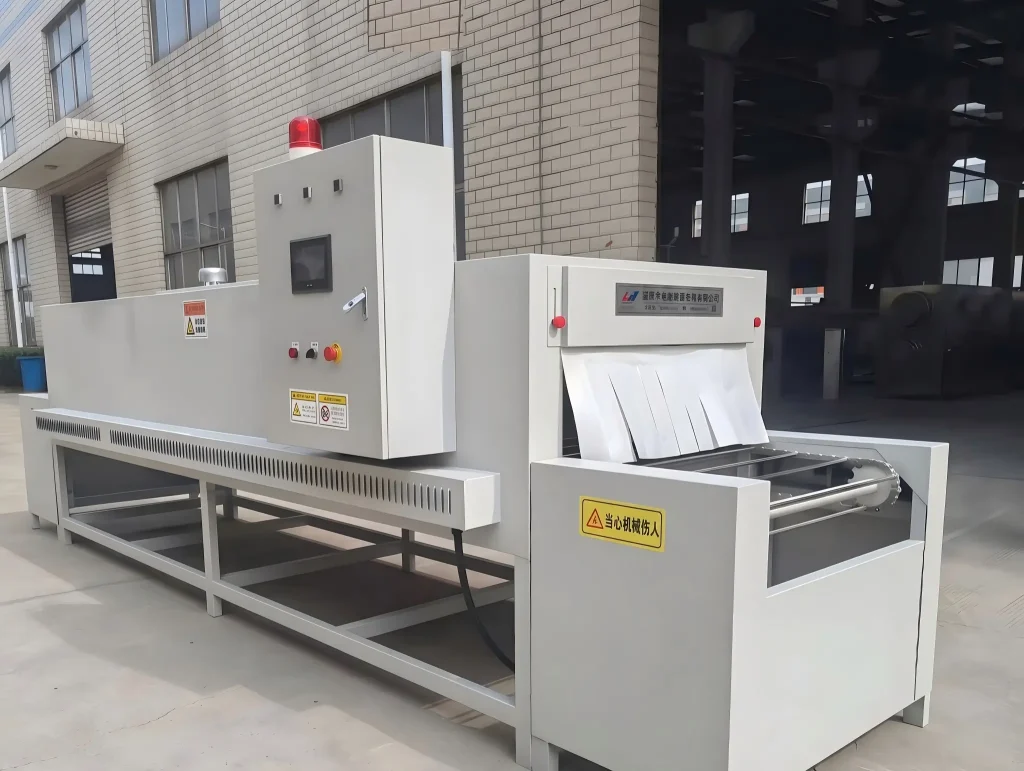
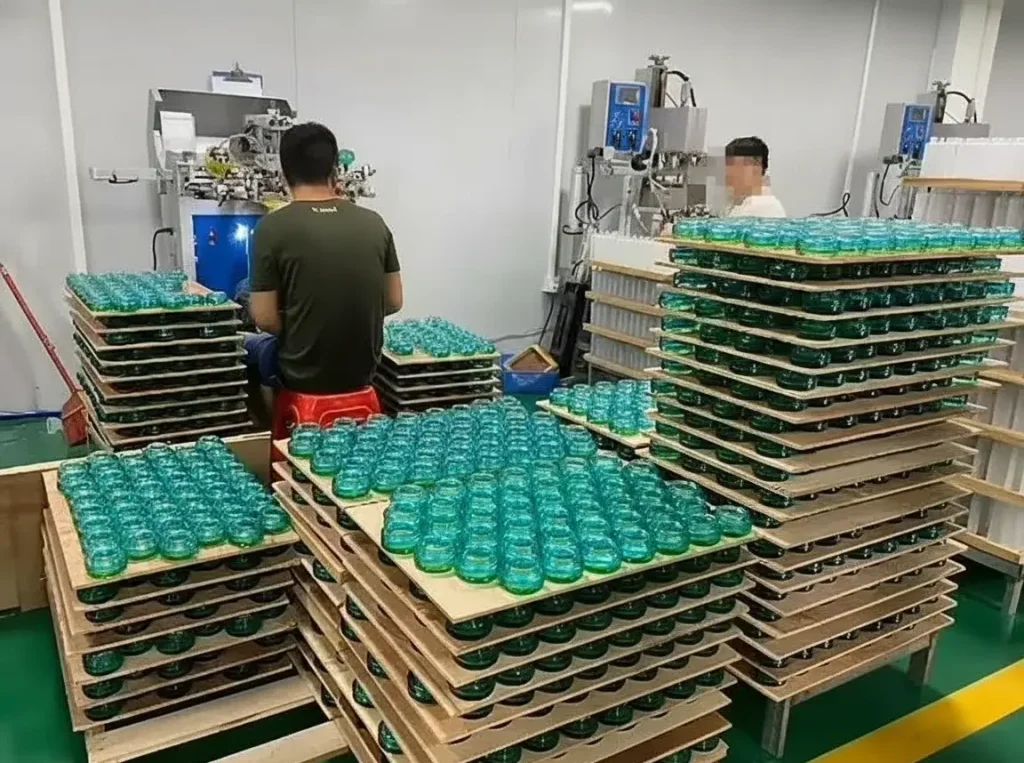
When printing on glass with a semi-automatic, the drying line must be longer than for plastic. Typically, a plastic bottle drying line is about 1.5 to 2 meters long, whereas a glass bottle line may extend to 5 or even 10 meters. This is because ink adheres less readily to glass and requires longer drying time.
However, the equipment for extended glass drying lines is costly. As a result, many manufacturers opt for air drying: after printing, glass bottles are placed on pallets and left to cure naturally for about 24 hours.
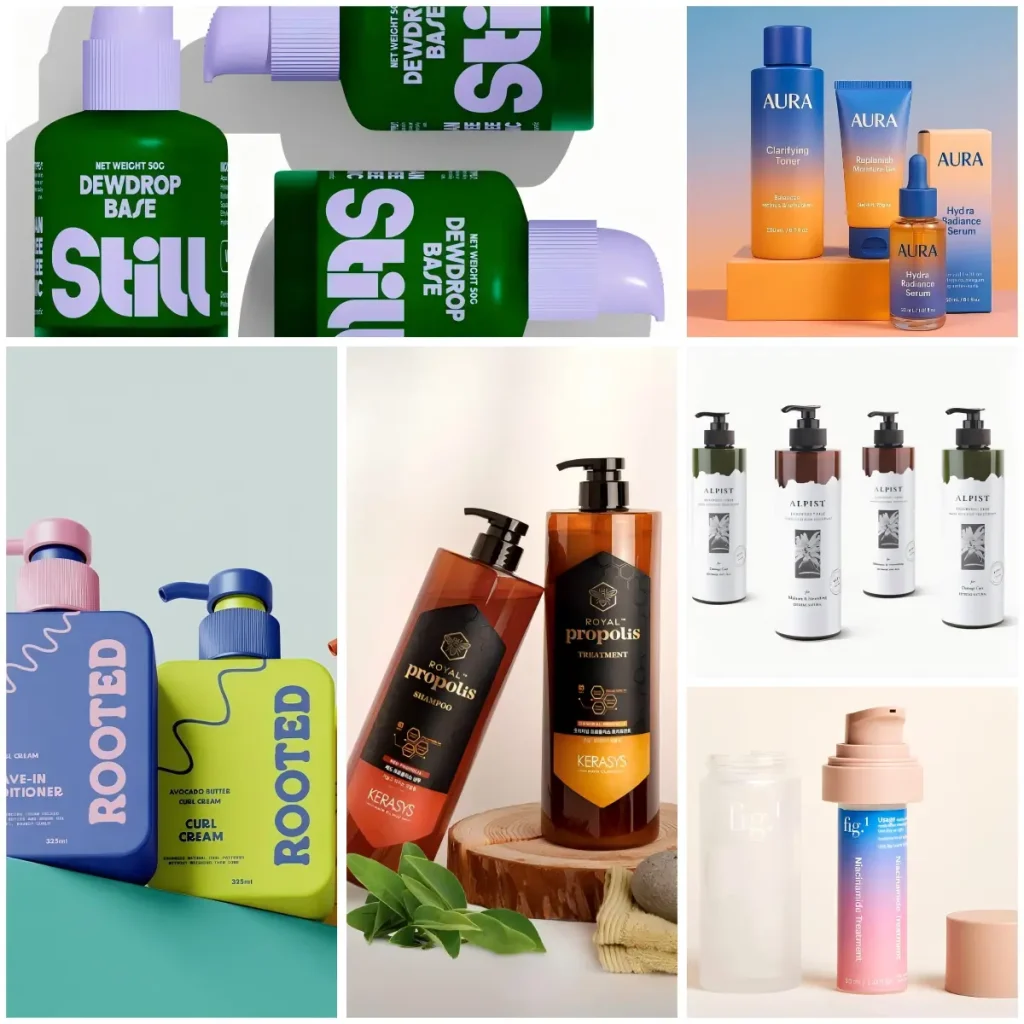
Regardless of the type of machine used, the cost of silk screen printing on round bottles is primarily determined by the number of colors—more colors mean a higher price. For square, triangular, or other irregular polygonal bottles, pricing also depends on the number of printed surfaces. Even if the entire bottle uses only one color, if both the front and side require printing, the cost is typically charged twice.
6. Silk Printing VS Labeling
Screen printing and labeling each have distinct characteristics. The choice between them largely depends on the design content.
If your design involves multiple colors and complex graphics, we would typically recommend labeling first from a cost perspective, as it is often more economical compared to multi-color screen printing.
If your text or color blocks feature gradients, label design is a relatively cost-effective option. Screen printing cannot produce gradient effects, as it is limited to solid colors or overprinting of separate colors.
Furthermore, the visual and tactile presentation on the packaging differs noticeably between the surface finishes. Labels may not adhere completely flush to the bottle, creating a visible seam between the label and the container. In contrast, screen printing integrates seamlessly with the bottle surface. The ink can also provide a raised texture, adding a sense of depth and a richer, more tactile quality to the printed design.
If you are still unsure which surface finishing to choose, feel free to share your design concept with us. We can provide not only a cost comparison but also a detailed analysis of the visual impact and finish for your packaging.

7. Silk Printing VS Pad Printing
The machinery, process, and core principle of pad printing are entirely different from those of screen printing. The central component of pad printing is a silicone rubber pad, which transfers a 2D image from an etched plate onto a three-dimensional object. To learn more about the pad printing production process, keep an eye out for our future updates.
Currently, most cosmetic bottles are printed using screen printing rather than pad printing. Pad printing is better suited for irregular, very small, or uneven surfaces, such as mobile phone buttons, toy faces, or pens, whereas most cosmetic bottles feature relatively regular shapes.
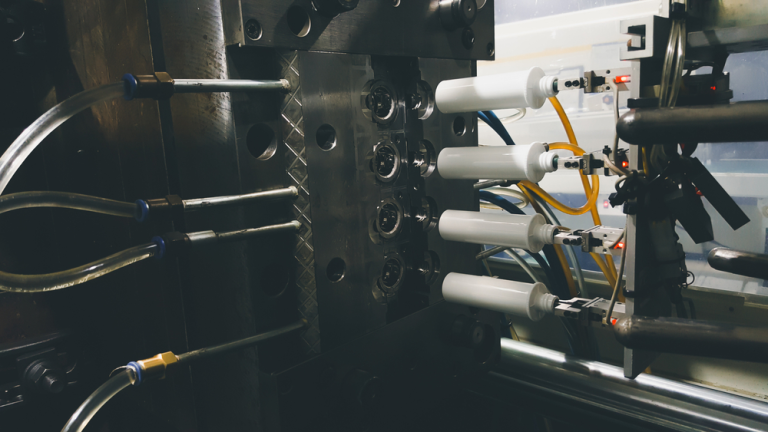
The examples above illustrate some applications of pad printing on pumps and lids on bottles. It can handle various curves and corners effectively. That said, compared to screen printing, pad printing typically produces a thinner ink layer and offers less tactile depth.
8. Silk Printing VS UV Printing
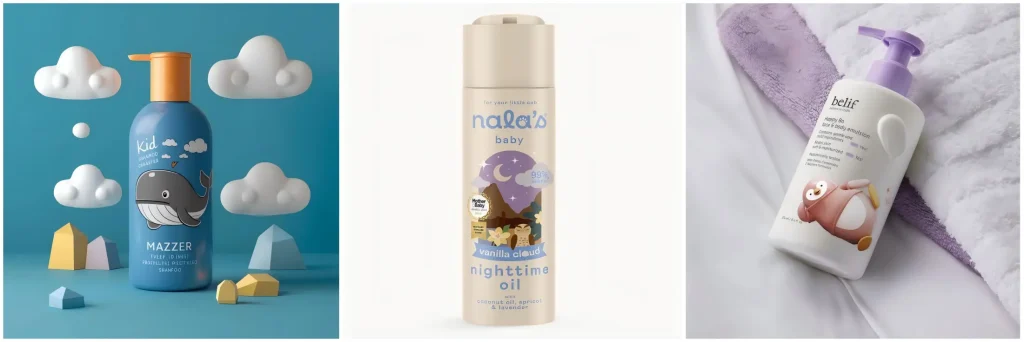
Demand for UV printing has been steadily increasing in recent years. For printing gradient patterns and multi-color designs, UV printing addresses some of the limitations of screen printing. The process and equipment for UV printing are simpler than those for screen printing. However, the cost and production time for UV printing are generally higher and longer compared to screen printing.
The cost calculation for UV printing differs from screen printing. It is not based on the number of colors but rather on the printing area and whether the bottle material requires pre-treatment. For example, UV printing on PP bottles is more expensive than on PET bottles because PP requires pre-treatment, such as flame treatment, to enhance ink adhesion.
Additionally, UV printing imposes higher requirements on bottle shapes compared to screen printing. It is suitable for printing on square and cylindrical bottles, but cannot accommodate curved or contoured surfaces, such as spherical bottles or the rounded sides of flat oval bottles. These areas remain unprintable with UV printing. Indeed, there is no doubt that for complex graphics and gradient multi‑color printing, UV printing holds a clear advantage over screen printing.

9. Silk Printing VS Heat Transfer Printing
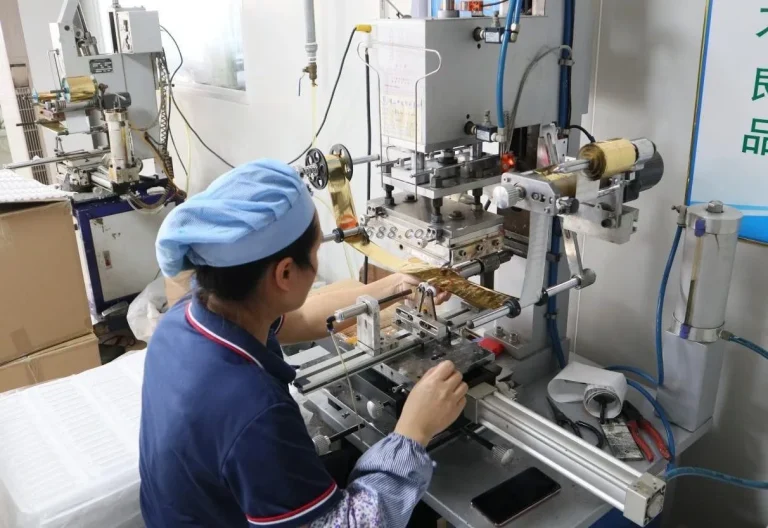
Unlike silk screen printing, heat transfer printing does not require a printing plate. The design is pre‑printed onto a transfer film. Through heating, the ink sublimates, and pressure applied by the pad allows the ink to penetrate the bottle surface.
Like pad printing, heat transfer is highly suitable for multi‑color printing. However, it cannot be applied to uneven surfaces and is limited to flat or uniformly curved substrates. This characteristic, to some extent, compensates for the challenge silk screen printing faces in achieving high‑quality prints on curved surfaces.
It is worth mentioning that heat transfer printing can handle different patterns and colors within the same production batch. Although its level of automation may not match that of screen printing, it offers greater flexibility and advantages when printing complex designs and colors.
10. Silk Screen Printing Service
As a packaging manufacturer with over a decade of industry experience, we believe that silk screen printing services should extend far beyond a simple price quote. We start by understanding the client’s design intent or artwork, then combine that with the desired texture effect and budget to provide tailored recommendations.
Our discussions go beyond just Pantone colors. Even for what may seem like a standard bottle, we pay close attention to printing details on the shoulder and base areas often overlooked by other suppliers. In the case studies shared above, you might have noticed that the same design can often be produced using different printing methods. The final choice depends on a range of factors, including print feasibility, lead time, budget, and the desired tactile and visual outcome.
If you still have questions about silk screen printing, or if you’re unsure how to bring your next packaging design to life, we invite you to reach out via Email – Manager@pagpackaging.com . Let us provide additional visual mockups and cost insights, so you can make a well-informed decision with practical, hands-on advice.