Book Categories:

There are many different ways to form plastic packaging, and injection molding is one of them. So, how do you choose the most suitable molding method for your product packaging? The core logic depends not only on the type of material used, but also on the structural design of the packaging. Among the various processes, injection molding, blow molding, and extrusion molding are the three most mainstream container-forming technologies. Today, we will focus on injection molding and provide you with an in-depth look at this great technology with over a century of remarkable history.
1. What Is Injection Molding?

The principle of injection molding is to heat and melt plastic pellets in the hopper, then inject the resulting plastic melt into a closed mold cavity. After cooling and solidification, the mold is opened, and the finished plastic part can be removed.
Injection molding is typically used to produce relatively complex structural parts with high precision requirements (such as caps, pump heads, and plugs), as well as hollow containers with thicker walls.
Almost all plastics that can be used for packaging — including PET, PP, PETG, ABS, PMMA, and others — can be processed in an injection molding machine. The specific material choice depends on the product’s application scenario, customization requirements, and production cost budget.
For example, cosmetic jars can be made from either PET or PP. If a thick, transparent wall is desired, PET injection molding is used. If transparency is less important and a softer, more matte texture is preferred, PP injection molding is a suitable choice.
2. How Does Injection Molding Work?
Complete injection molding production of plastic parts includes the following 5 steps. If you would like to understand the specific operation of an injection molding machine, please click the video above to view.
2.1 Drying the Material
Raw materials typically need to be dried before formal injection molding. The purpose is to remove moisture, allowing the plastic pellets to melt and plasticize more effectively in the injection molding machine, thereby ensuring molding quality. It is worth noting that different types of plastics and different requirements for injection-molded parts have different drying temperatures and time settings. Whether the material is thoroughly dried has a significant impact on the quality of the finished product: if drying is insufficient, the surface of the injection-molded part may show unremovable water mark-like streaks. Additionally, a few special materials, such as PP, PS, and PE, typically do not require drying pretreatment.
2.2 Adding Color Masterbatch
If the injection-molded parts require custom colors, a predetermined proportion of color masterbatch must be added to the raw material for color adjustment prior to injection molding production. If the parts being produced are natural (uncolored) plastic parts, this step can be omitted.
2.3 Injection Molding
Although injection molding is a highly automated technology, the adjustment of equipment process parameters and material pretreatment methods varies depending on the material and the structure of the injection-molded part. Furthermore, even when producing a single product — with equipment parameters and mold structure kept unchanged — the injection molding machine may not guarantee 100% defect-free, stable production.
Mold wear, aging of machine components, and changes in ambient temperature and humidity affecting material pretreatment can all lead to unpredictable defects in the final injection-molded parts. Therefore, injection molding places high demands not only on process technicians responsible for equipment adjustment, but also on quality control personnel on the production line and mold maintenance staff.
2.4 Sprue/Runner Trimming

After an injection-molded part is ejected from the mold, it usually has excess “sprue/runner material” (also known as runner scrap) attached. This is formed by the plastic solidifying in the runner system from the injection molding machine nozzle to the mold cavity.
The principle is that the molten plastic must first fill this runner before entering the product cavity. During cooling and ejection, the plastic in the runner is ejected together with the product. Typically, this runner material needs to be separated and removed from the product, either manually or by automatic trimming equipment on the production line. If not properly cleaned off, residual runner material left on the packaging can create unsightly flash and pose a risk of scratching personnel.
The separated runner material is typically high-quality recyclable material and should be properly sorted and sent to designated recycling facilities for processing. If untreated recycled material is directly mixed with virgin material for production, it can easily lead to poor molding and more appearance defects in the injection-molded parts.
2.5 Quality Inspection and Packing
Quality inspection processes and standards vary depending on the material and type of injection-molded part. Taking preform injection molding as an example, full inspection on the production line is typically adopted. Since these plastic pieces are preforms for container blow molding, their appearance quality directly affects the success rate of subsequent packaging molding and the appearance defects of the final container. Therefore, when producing PET preforms, we typically arrange at least 1–2 quality inspectors on the production line to perform simultaneous quality checks and packing at the ejection area.
For softer materials such as PP and PE that are less prone to scratching — such as bottle caps — the usual practice is to conduct sampling inspections while simultaneously handling defective parts on the line.
3. Advantages of Injection Molding
The same type of plastic can be molded using different methods depending on the structural design of the finished part. Take PET and PP as examples: for thick-walled jars or caps that require higher thickness and precision, injection molding is typically used. For hollow containers, blow molding is the preferred method.
Injection molding is one of the most widely used, most mature, and most representative molding methods in plastic processing, largely due to its inherent advantages. By taking a deep dive into both the strengths and limitations of injection molding, we hope to help you gain a more comprehensive understanding of plastic packaging molding processes and build a solid knowledge foundation for your future packaging development work.
3.1 High Precision Molding
Injection molding achieves the highest dimensional accuracy and the ability to replicate complex details. This is due to its fully enclosed, high-precision mold, combined with extremely high injection pressure and clamping force, meaning the final dimensions of the product are almost entirely determined by the mold and are less affected by process fluctuations.
In contrast, blow molding operates at much lower molding pressures. It simply inflates a molten preform, pressing it against the inner walls of the bottle mold to form a hollow plastic part. For the stable production of parts with fine threads, snap-fits, or other complex features (such as bottle caps), both the lower pressure and the quality of the parison in blow molding pose significant limitations.
3.2 Ability to Mold Complex Functional Structures
Blow molding can also achieve a certain degree of “irregular shapes,” such as curved waistlines on bottles, anti-slip textures, or animal-shaped contours — essentially surface-level curvature variations. However, when it comes to functional complex structures — such as the tamper-evident snap ring inside a bottle cap, the internal liquid channels inside a pump head, embedded threads on the container wall, or locking slots for securing components — blow molding is not up to the task.
Plastic parts with such fine internal features or asymmetrical geometries can only be completed by injection molding machines. Due to the physical constraints of low-pressure molding and parison expansion, blow molding cannot form precise concave/convex structures or overhanging features inside a part — yet these are routine operations for injection molding.
3.3 One‑Shot / Integrated Molding
Injection molding enables a variety of “integrated molding” solutions, which greatly simplify subsequent assembly processes.
The first is insert molding: by pre‑placing metal inserts such as threaded studs or aluminum parts into the mold, the plastic flows around them during injection, forming a strong, permanent bond. For example, the built‑in nut in a pump head is often made this way, eliminating the need for post‑molding heat‑staking or ultrasonic insertion.
The second is two‑shot / multi‑material injection molding: this process uses two independent injection steps within the same mold to join two different materials or two different colors into a single, finished part. A typical example is a camera body or game controller, where the main body is made of a rigid plastic (e.g., PC/ABS) and the grip area is covered with a soft elastomer (e.g., TPE/TPU). The two materials are seamlessly and firmly bonded through multi‑material injection molding.
3.4 Wide Material Compatibility
One of the fundamental reasons injection molding has become the most widely used plastic processing method is its exceptional compatibility with a broad range of materials. From PP, PET, AS, ABS to PMMA — nearly all types of thermoplastics can be processed through injection molding.
However, it is important to note that injection molds are material‑specific. For example, a mold designed specifically for PET cannot usually be used directly for PP production. This is because different plastics have different flow characteristics, shrinkage rates, and other properties in their molten state. The mold is engineered to match the parameters of the intended material. Using a different material not only affects part quality and production efficiency but may also cause irreversible damage to the mold.
3.5 Low Material Waste
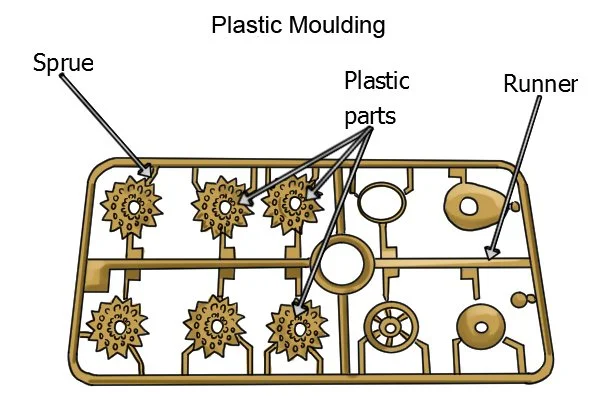
As mentioned earlier, the sprue and runner generated during injection molding typically have not undergone complex surface finishing processes and are of clean quality. As a result, they hold high value in the recycling system. At PAGpackaging, we not only recycle this runner material but also use it for equipment purging.
When switching from molding colored plastic to producing transparent or another color, we use clear runner material to purge the injection molding machine screw and barrel. Melting and running this natural runner material effectively removes residual color from the machine, preventing contamination — such as color streaks or black specks — in the next production batch. This approach makes use of material that would otherwise be discarded and avoids the higher cost of using virgin material for purging.
Overall, the raw material utilization rate in injection molding typically reaches 85–90% or higher, resulting in much lower waste compared to processes such as extrusion molding or thermoforming.
3.6 Supports Diverse Color Customization

For packaging in cosmetics and consumer goods, color is often a key element of product identity and brand tonality. The advantages of injection molding in color customization run through the entire process — from “color matching” to “molding” to “color changeovers.”
Color matching for plastic parts typically requires the assistance of a color masterbatch supplier, who provides masterbatch with a designated color code. Once the masterbatch is added to the raw material in the specified proportion, and as long as the injection molding process parameters remain stable, the color difference within the same batch — or even between different batches — can be kept extremely low (typically ΔE < 0.5), meeting the strict color consistency requirements of cosmetic packaging.
Beyond basic color effects such as translucent or solid colors, injection molding can also produce plastic parts with metallic finishes, pearlescent lusters, or other special visual effects — uniformly and without risk of peeling — by adding special-effect pigments such as pearlescent, metallic, or glow-in-the-dark powders. These effects are often difficult to achieve with other molding processes or would require secondary spray coating.
Furthermore, injection molding can achieve gradient color effects. In the past, gradient colors typically required secondary spray coating. Today, by using a two-shot injection molding machine to mold gradients directly, manufacturers can reduce process steps, lower costs, and improve environmental sustainability.
3.7 Supports In-Mold Decoration
In addition to color customization, injection molding can also achieve in-mold labeling, which can, to some extent, replace traditional printing or labeling. The core process of In-Mold Film (IMF) technology is as follows: pre-printed film sheets are placed — one by one — into the mold cavity and held in place by electrostatic or vacuum suction. Then, injection molding is performed. As the molten plastic fills the mold, it fuses with the film under high temperature and high pressure. After cooling, the two are firmly bonded together as one.
The main differences between in-mold labeling and conventional labeling are a more natural appearance and fewer design constraints.
More natural appearance: In-mold labels seamlessly fuse with the surface of the injection-molded part, eliminating the raised label edge commonly seen with conventional labeling. The overall effect is as if the pattern has grown directly on the packaging surface.
Fewer design constraints: Conventional labeling requires reserved space for the labeling machine’s fixtures, typically leaving large blank areas at the top and bottom of the bottle. In-mold labeling requires no such reservation, allowing the design to cover a larger, more complete area of the packaging surface.
In-mold labeling not only delivers rich color and pattern effects but can also reproduce complex textured images, and the labels will not peel off due to friction or water exposure, offering excellent durability. This technology is widely used not only for automotive plastic parts, but also in food packaging, such as milk tea cups and disposable drink cups.
3.8 Support for Surface Texture Customization
In addition to color and pattern customization, injection molding can also directly determine the physical tactile feel and gloss level of the plastic part’s surface, without the need for secondary spray coating or additional treatment.
The cavity surface of an injection mold can be processed to different roughness levels through techniques such as texture etching (graining) or high-gloss polishing. When the molten plastic fills the mold, it precisely replicates the microscopic texture of the mold surface. This means that the injection-molded part can achieve a uniform matte or frosted effect directly after molding, with a fine tactile feel, and is not as easily scratched as a spray-applied coating.
Achieving a matte effect through a customized injection mold eliminates the need for a spray coating process, offering clear advantages in cost control, production efficiency, and environmental friendliness. It is worth noting, however, that whether the mold is made with a matte or glossy finish does not affect the mold development cost. The catch is that the matte or glossy effect is fixed – once the mold is made, it cannot be changed. Therefore, before deciding to customize the mold, you should take a long-term view and consider whether your product packaging needs to maintain a consistent matte finish. If you want the flexibility to offer a variety of tactile effects for your products, a glossy mold may better suit your needs than a matte one.
3.9 Greater Flexibility in Mold Customization
Compared to blow molding, injection molding offers a relatively higher degree of flexibility even after the mold has been made. The “flexibility” here does not refer to how complex or precise a structure injection molding can produce, but rather to the ability to modify certain product dimensions or key features — to some extent — by replacing local inserts, cores, or cavity blocks within the mold, without having to build an entirely new mold.
A typical example is modifying the neck finish of a PET preform. For instance, a preform originally designed with a 24/410 neck finish can be changed to a 24/400 finish by replacing the corresponding insert. This kind of adjustment allows the same preform body to fit a wider range of caps or pump heads, greatly improving the mold’s versatility and the product’s adaptability. Similarly, the wall thickness of PET thick‑wall jars can also be adjusted by modifying the cavity parameters.
It should be noted, however, that not all structural changes can be achieved through original mold modifications. For example, the wall thickness of PET thick‑wall jars generally cannot exceed 5mm; beyond that, the material is prone to crystallization and whitening. Whether this approach is feasible depends on the specific product parameters — such as neck height, width, and other dimensions — and must be evaluated case by case to determine the possibility of the modification.
3.10 High Production Efficiency
The efficiency advantages of injection molding are primarily reflected in two aspects: the number of mold cavities and the cycle time. Injection molds are typically designed with multiple cavities — the smallest common configuration is 4 cavities, with 8, 16, or even more cavities being standard. In contrast, blow molds are often 1 cavity or 2 cavities, with significantly fewer cavities. On the surface, this may seem like just a difference in mold size, but in reality, the number of cavities directly determines how many parts are produced each time the machine cycles — meaning that every time the injection molding machine opens and closes, it can simultaneously produce several times more parts than a blow molding machine.
In addition, the cycle time for injection molding is much shorter than that for blow molding or extrusion molding. It typically takes only a few seconds to a few tens of seconds, and within that short time, multiple parts are produced simultaneously (the exact number depends on the number of mold cavities).
The combination of these two factors results in a significant difference in production output. An injection molding machine running 24 hours a day can produce 30,000 to 40,000 or even more plastic parts per day. In contrast, a blow molding machine operating for the same amount of time might achieve only 10,000 parts at best. This order‑of‑magnitude difference is not just a theoretical comparison in production efficiency — for large‑scale packaging manufacturing, it directly determines cost competitiveness and the upper limit of delivery capacity.
3.11 High Level of Automation
Injection molding is one of the most highly automated plastic processing technologies available today. Because injection molding has the greatest demand and the widest application in the packaging field, injection molding machines have undergone multiple rounds of technological iteration. The supporting auxiliary equipment — such as automatic runner separators, preform conveying systems, and visual appearance inspection systems — has also become increasingly mature and widely adopted.
This means that injection molding production is relatively less dependent on the number of technical personnel. A single technician can operate multiple injection molding machines simultaneously, while also handling routine inspections, material loading, and troubleshooting.
3.12 Stable Quality with Low Defect Rate
For large-scale packaging production, the quality of an individual part is certainly important. However, what matters even more is that every batch and every part consistently meets the same high standard. Injection molding’s performance in this regard is a key reason why it has become a mainstream process in the packaging industry.
The quality of each injection-molded part is primarily controlled by the core process parameters of the injection molding machine — such as injection pressure, injection speed, and melt temperature. These parameters can be precisely set and controlled through closed-loop systems. Once the process parameters for a specific product have been optimized and fixed, they can be executed stably over the long term, minimizing differences in quality between different production batches.
At the same time, the high degree of automation and high mold precision mentioned earlier are also reasons why injection molding can consistently produce stable-quality parts. For brands, stable quality in injection molding means lower defect rates, fewer after-sales complaints, and more reliable delivery quality.
4. Limitations of Injection Molding
Admittedly, no plastic molding process is perfect. While injection molding offers many irreplaceable advantages, it also has certain drawbacks that can be less favorable for buyers – issues that manufacturers themselves have long been grappling with.
Below are three factors related to injection molding that have a significant impact on purchasing decisions. Understanding these limitations before choosing injection-molded packaging will help you make more informed procurement judgments.
4.1 High Mold Investment Cost
As mentioned earlier, injection molds typically have a high number of cavities, so generally speaking, the development cost of an injection mold is often several times higher than that of a blow mold or an extrusion mold. Even for small-sized caps, the mold development cost is likely to be higher than that of a 1-liter or 2-liter bottle.
However, mold development is not simply about choosing a lower cavity count. It requires a comprehensive evaluation of multiple factors, including the product’s annual purchase quantity, gram weight, material properties, and more. For products with high annual demand (e.g., over one million units per year), a 12-cavity mold is often more cost-effective in terms of unit price and delivery lead time than a 4-cavity mold.
If you have precision injection-molded parts you’d like to develop and would like to understand the mold costs and unit price estimates, feel free to reach out to us for a consultation. Whether it’s caps or bottles, we can provide professional advice and tailor a packaging development solution that fits your budget and procurement needs.
4.2 Long Development Cycle
The development time for injection molds is typically longer than for blow molds or extrusion molds. For container-type packaging, mold development (including initial drawing verification, 3D sampling, mold fabrication, and testing) generally takes only about 10–15 days. For precision components such as pump heads and caps, however, the injection mold development cycle is at least 40 days.
It is worth noting that, for the same order quantity, the production cycle of injection molding is much shorter than that of blow molding or extrusion molding.
Nevertheless, the choice of molding process for a new product is not ultimately determined by the development cycle — the deciding factor is always the structural design of the product. Understanding the injection molding development cycle in advance is simply meant to help you better plan your product development and launch timeline.
4.3 High MOQ Threshold
Many of our customers, when making inquiries, often wonder: why is it that for some plastic packaging the MOQ is only a few thousand pieces, while for others it has to be tens of thousands? The dividing line usually comes down to whether injection molding is involved, or whether the packaging requires production‑intensive, complex customization processes such as spray coating, electroplating, or water transfer printing.
Injection‑molded containers generally have a higher MOQ than blow‑molded ones — typically starting at 10,000 pieces, and for certain specialized pump heads or caps, the MOQ can even reach 20,000 pieces. This threshold is not arbitrarily set by the factory; it is determined by the inherent characteristics of injection molding itself.
As mentioned earlier, injection molds have a high number of cavities and relatively high development costs. To make the unit cost of injection‑molded parts competitive, our current minimum mold cavity configuration is 8 cavities, and it can go as high as 32 cavities. This high‑capacity design usually requires sufficiently large order volumes to cover the various energy and amortization costs during production. Even though injection molding is a highly automated process, the steps involved — material drying, injection molding, quality inspection, testing — still entail significant costs. If order volumes are too small, the time, material, and energy costs associated with frequent mold changes, machine adjustments, and cleaning increase significantly, and the high‑output advantage of the injection molding machine cannot be fully realized.
Moreover, a complete package is rarely limited to a single process. For example, a blow‑molded plastic bottle often needs to be paired with injection‑molded caps, pump heads, and other components. If you then add personalized processes such as printing, spray coating, or electroplating, it becomes very difficult to keep the MOQ as low as a few thousand pieces. The suppliers of these components and processes also set their own MOQ thresholds based on their production capacities. If the order volume is too low, you may not only need to pay additional setup fees, but the unit cost of freight will also rise.
For these reasons, many factories base their quotations on a starting point of 10,000 pieces. If the procurement quantity is too low, it not only becomes difficult to coordinate upstream and downstream production capacity, but the overall packaging price may also lose its market competitiveness, which is not a cost‑effective deal for either the supplier or the buyer.
5. Injection Molding Solution
As a supplier with over a decade of experience in injection molding, we have developed unique insights and expertise in the forming of plastic parts. When providing product development solutions for our clients, we not only answer technical questions but are also willing to offer clear development cost analyses based on your specific needs — from mold selection and material matching to capacity planning — helping you find the optimal balance between technical feasibility and commercial viability.
If you are weighing options for packaging development, please feel free to reach out to us. Let our professional experience provide you with solid references for your decision-making.