Book Categories:

1. What Is PCO In PET Preform?

Among the many specifications of PET preforms, PCO1881 and PCO1810 are undoubtedly the two most representative neck finish standards in the global beverage packaging industry today. To understand the difference between the two, it is first necessary to clarify what a PCO preform is — PCO is the abbreviation for “Plastic Closure Only.” It is the standard designation for carbonated beverage bottle neck finishes issued by the International Society of Beverage Technologists (ISBT), referring to the thread finish standard specifically designed for plastic bottles.
Although PCO preforms are available in two different models, both share a fixed neck outer diameter of 28mm. This uniformity ensures that across different generations of preforms, they remain compatible with mainstream closures and accessory supplies in the market.
Currently, PCO preforms are primarily used in packaging applications with high airtightness requirements, such as drinking water and carbonated beverages. They are also commonly found in personal care and household chemical products — particularly in cases requiring tamper-evident caps or containing alcohol-based ingredients, where higher sealing performance is needed; PCO preforms tend to be the preferred choice. In terms of finished bottle capacity, PCO preforms typically cover a wide range from 250ml to 2L.
2. The Differences Between PCO1810 And PCO1881

The birth of PCO preforms almost coincided with the rise of PET bottles in the late 1970s, but the emergence of the PCO1810 and PCO1881 standards was not simultaneous. In the early days, most PET neck finishes drew heavily from existing glass bottle specifications — such as the BPF standard established by the British Plastics Federation — with neck weights reaching as high as 5.8g.
As injection molding and blow molding technologies advanced, the industry introduced the first neck finish standard specifically optimized for plastic closures: PCO1810. This specification not only achieved initial weight reduction but also ensured good compatibility between caps and bottle necks through precise thread design, effectively preventing leakage or sealing failures caused by thread mismatch. This standard was subsequently widely adopted and became the classic specification for carbonated beverage bottle necks.
Entering the 21st century, in order to further reduce production costs and respond to growing environmental concerns, leading industry players began promoting the development of a new generation of lightweight neck finish standards. In 2007, relevant companies initiated formal discussions on the new standard at the International Society of Beverage Technologists (ISBT) forum. After more than two years of technical evaluation, the PCO1881 standard was officially finalized in 2009. Compared to PCO1810, PCO1881 incorporates systematic improvements in key parameters such as neck height (Thread Height), thread pitch, and thread turns (Thread Travel). For detailed differences, please refer to the table below.

Actual dimensions should be confirmed with samples or drawings from your supplier.
As can be seen from the table above, as an upgraded version of PCO1810, PCO1881 features fine-tuned adjustments in thread pitch, thread height, and thread turns, ultimately reducing the neck weight by 24.7% (from 5.06g down to 3.81g, a reduction of 1.25g).
Many people may not intuitively grasp how such minor numerical changes could have such a profound impact on the industry. Below, we will analyze the specific transformations that the advent of PCO1881 has brought to the plastic bottle industry from the following perspectives:
2.1 Reduced Thread Height
PCO 1881’s neck is about 4mm shorter than PCO 1810. This means less material per unit and a faster molding cycle, lowering production costs. You might think this only helps the preform supplier, but as we’ll see below, the benefits actually flow all the way down to buyers and beverage brands.
2.2 Reduced Thread Turns
PCO 1881 features shorter thread turns, reducing the cap tightening rotation angle from 810° (approximately 2.25 turns) to 650° (approximately 1.5 turns). This change directly improves the capping efficiency of the filling line, thereby increasing overall line throughput. Let’s use a set of hypothetical data to visualize this benefit:
Assume a beverage plant produces 1,000 bottles per hour, with fixed costs (equipment depreciation, labor, electricity, facility rent, etc.) totaling $100 per hour. The fixed cost per bottle would then be $0.10.
After switching to PCO 1881, the shorter capping turns increases line speed, boosting throughput to approximately 1,500 bottles per hour. With fixed costs remaining unchanged, the fixed cost per bottle drops to approximately $0.067.
Of course, the above figures are purely hypothetical and intended only to illustrate the cost dilution effect brought about by increased output per unit of time. Actual cost savings should be calculated based on the specific production line configuration and local operating costs.
2.3 Reduced Thread Pitch
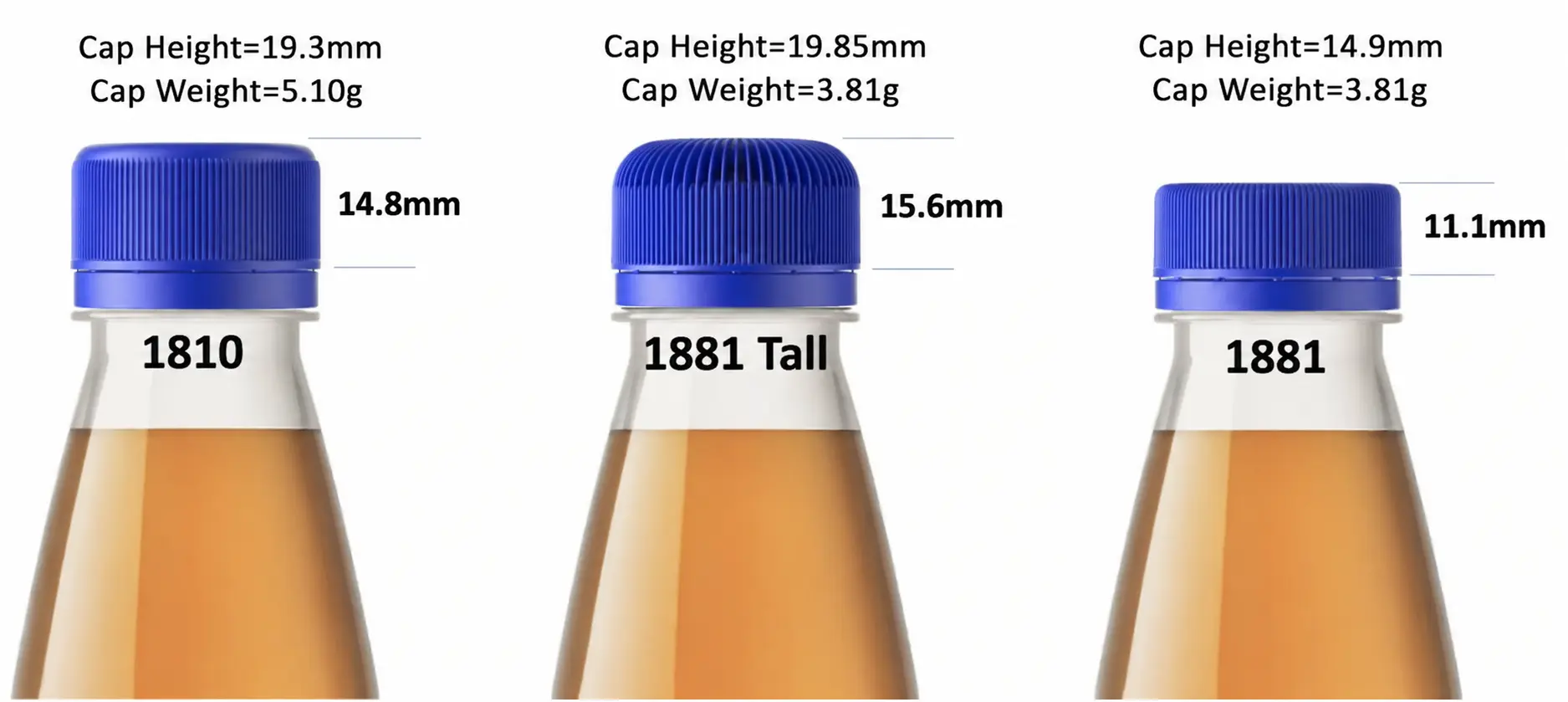
From an engineering structural perspective, although PCO1881 reduces material usage, it compensates for the loss of strength by increasing the thread density per unit height — that is, by reducing the thread pitch. Therefore, despite using less material, its sealing performance is not compromised. Furthermore, the reduction in thread turns and pitch also indirectly contributes to reduced cap material consumption and improved production throughput, which undoubtedly represents an upgrade for the entire beverage packaging supply chain.
2.4 Reduced Neck Weight
The neck weight of PCO1881 is 1.25g lighter than that of PCO1810. For buyers, when selecting preforms for products with the same capacity and bottle height, they now have a more lightweight option to choose from.

Above, we have compiled a comparison of selected weight specifications between PCO1881 and PCO1810 preforms (the weights listed generally correspond to bottles blown to capacities of 350ml–650ml).
Assuming the same 500ml bottle is produced, choosing the PCO1881 preform offers an overall weight reduction of approximately 2% compared to PCO1810. At the same unit price per gram of preform material, this 2% translates directly into cost savings on procurement. Although 2% may seem negligible, the cumulative effect becomes quite significant in bulk purchasing and large-scale production. Let’s use another set of hypothetical data to illustrate the contribution these marginal changes make at the level of sustainable packaging:
Assume a beverage supplier uses PCO1810 preforms at 18.0g per unit, producing 50 million bottles of 500ml beverages annually.
After switching to PCO1881 preforms at 17.5g per unit, each bottle achieves a weight reduction of 0.5g.
Annual total weight reduction: 0.5g × 50 million bottles = 25 tons.
At a PET raw material price of $1,000/ton, the annual material cost savings amount to: $25,000.
Although the figures above are hypothetical, the logic behind cost reduction and efficiency improvement remains consistent. You can also apply your own production volume and cost data to the same approach to calculate the specific savings that switching PCO preform types would bring to your operation.

Additionally, it is worth noting that the weight reduction of the neck does not necessarily have to translate into cost savings — it can also be leveraged to create additional design margin for bottle reinforcement.
For example, in the hypothetical scenario above comparing 17.5g vs. 18.0g preforms, if the overall preform weight is kept unchanged and only the neck is replaced, the 1.25g saved from the neck could be redistributed to increase the sidewall thickness of the bottle body, thereby enhancing product strength. Of course, the design cost and feasibility of such a conversion would still need to be evaluated in conjunction with the specific bottle mold design.
2.5 More Environmentally Friendly Production
The parameter optimization of PCO1881 is in itself a quantifiable sustainability initiative. From its lightweight neck design, it directly reduces plastic consumption per unit, lowering the carbon footprint at the source. However, lightweighting is only part of its environmental value — the more far-reaching impact is reflected in the following aspects:
2.5.1 Systematic Material Reduction Effect
The weight reduction of PCO1881 is not limited to the neck itself — thanks to its structural optimization, the matching closure also achieves a simultaneous weight reduction. This means that each neck + cap combination could save approximately 1.7g of plastic. On an annual production scale of 1 billion bottles, this translates to a reduction of approximately 1,700 metric tons of plastic consumption at the neck and cap level alone. This “component-linked weight reduction” effect is what sets PCO1881 apart from any previous incremental adjustment.
2.5.2 Reduced Carbon Footprint Across the Entire Supply Chain.
Lighter preforms mean more products can be loaded under the same transportation conditions, reducing energy consumption per unit shipped. Shorter neck height results in lower pallet stacking height, improving warehouse space utilization. Faster filling speeds mean lower energy consumption per unit of output. While these may seem like secondary factors, their combined environmental benefits in large-scale operations are significant.
2.5.3 Regulatory Compliance and Circular Economy
The neck finish of PCO1881 is also compatible with tethered caps, meeting the EU regulatory requirement that single-use plastic beverage containers of 3L and below must use tethered caps. The tethered cap design not only reduces environmental pollution caused by discarded caps, but also aligns with the global policy direction of gradually reducing single-use plastic products.
2.5.4 Positive Implications for Life Cycle Assessment (LCA)
From raw material extraction, transportation, injection molding, filling, logistics, and distribution, to final disposal, PCO1881 generates positive environmental benefits at every stage due to being “lighter, shorter, and faster.” Although the reduction per individual bottle is minimal, when this standard is applied to hundreds of billions of beverage bottles produced annually worldwide, the cumulative environmental benefit is unmatched by any end-of-pipe treatment measure.
3. How To Choose PCO Preforms?

From the above analysis, it is clear that the iterative upgrade from PCO1810 to PCO1881 — while appearing to be merely a minor parameter adjustment — is in fact a systematic optimization project that masterfully integrates precision engineering, economic efficiency, and environmental sustainability. From the perspective of lightweight packaging, PCO1881 seems to hold an overwhelming advantage. However, switching from PCO1810 to PCO1881 is not a zero-cost decision, nor should the choice between the two preforms be based simply on which is “newer” or “lighter.” Below, we will analyze the key factors to consider when selecting PCO preforms in real-world application scenarios.
3.1 Equipment Compatibility
If you are still in the early stages of planning your PET packaging production line, we believe the above data analysis and case studies can provide you with a clear cost reference for specification selection and initial investment. For existing production lines currently designed for PCO1810, switching to PCO1881 is not a cost-free decision.
Although the iterative upgrade of PCO preforms does not change the neck outer or inner diameter, the optimized adjustments in thread parameters, gram weight, and other aspects will still necessitate adaptations across various stages of the beverage production line to a certain extent. Below, we have outlined the potential modification items that may be involved across the entire beverage packaging supply chain (enterprises can refer to the corresponding cost estimates based on their own line configurations).

From the above analysis, it is evident that switching between PCO1881 and PCO1810 preforms is not a low-cost decision for packaging and filling suppliers — virtually every process that comes into contact with the neck finish and its associated components will require adjustment. Therefore, whether to change the preform specification must be carefully evaluated based on the company’s existing equipment configuration, combined with practical factors such as overall operating costs and production volume expectations, in order to assess the feasibility and potential incremental benefits of the conversion.
For vertically integrated enterprises that combine preform injection molding, bottle blow molding, and filling operations in one facility, it is especially important to accurately calculate the modification costs at each stage to ensure that the final product remains both competitively priced and offering unique, comprehensive advantages that are difficult to replicate.
3.2 Strength and Durability
While PCO1810 may not be as optimized as PCO1881 in terms of weight reduction, its neck structure is more robust and features a longer thread, offering higher mechanical strength and making it better suited for large-capacity containers. Currently, our PCO1810 preforms can go up to 55g in weight, capable of blow-molding bottles up to 2L in capacity, whereas our PCO1881 preforms max out at 52g and are mostly used for blow-molding 1.5L bottles.
In the functional beverage segment and applications requiring frequent opening and closing, some manufacturers still prefer PCO1810 — its longer thread structure provides better durability for repeated screwing and unscrewing. In addition, the thicker neck design helps reduce the risk of deformation or damage during filling, transportation, and storage. Therefore, the decision to switch to PCO1881 should not be based solely on cost considerations, but also on a comprehensive assessment of specific packaging capacity requirements and bottle body design.
3.3 Sustainability Packaging Requirements
As discussed above, the upgrade of PCO1810 has a quantifiable and traceable environmental impact. For companies that position sustainability at the core of their brand identity, the choice of neck finish specification carries strategic importance that far outweighs visual design elements such as packaging color or bottle shape — because lightweighting achieves plastic reduction at the very source of product design, representing a fundamental measure to reduce fossil fuel consumption and lower carbon footprint.
Unlike approaches that achieve environmental goals by reducing surface customized designs on the packaging, the advantage of neck lightweighting lies in its precise calculability and transparent communicability to consumers. Taking PCO1881 as an example, the neck structure optimization alone reduces plastic usage by approximately 24.7% — a figure based on the actual reduction in neck gram weight from 5.06g to 3.81g. Based on annual production volume, companies can accurately calculate the total annual plastic reduction and translate it into environmental achievements that are easily understood by the public.
This data-driven environmental narrative is far more compelling than vague claims of “eco-friendly packaging” or “green packaging.” When consumers can visually see “how much plastic was saved” or “how much carbon emissions were reduced,” the brand’s sustainability commitment ceases to be an abstract slogan and becomes a tangible, verifiable practice. For companies seeking to build brand loyalty through environmental values, this represents a communication approach that combines credibility with strong messaging impact.
4. Let’s Find Your Fit
In summary, there is no absolute superiority of one over the other between PCO1881 and PCO1810 — only different fits for different scenarios. PCO1881 represents the trend toward lightweighting and environmental sustainability, with clear advantages in mainstream carbonated beverage capacities. PCO1810, with its more substantial structure, still holds its ground in large-capacity packaging and high-frequency usage scenarios. When selecting preforms, companies need to take a holistic view of product positioning, filling processes, existing equipment, and regulatory requirements in target markets — rather than simply chasing the “latest standard.” After all, the best choice is the one that fits your needs most closely.
If you still have questions about PCO preform selection after reading this article, we welcome you to reach out and discuss your project requirements with us. We will leverage our existing PCO1881 and PCO1810 mold solutions to recommend the most suitable preform specification for your needs and provide corresponding price references to help you make a clearer and more confident procurement decision.