Book Categories:

1. Definition of Eco Friendly Packaging
Eco friendly packaging refers to a packaging form that, while fulfilling product protection and usage functions, imposes the minimum overall impact on the natural environment across its entire lifecycle—including raw material extraction, manufacturing, distribution, consumer use, and end-of-life disposal.
That said, under current technological conditions and industrial scales, there is hardly any packaging that achieves “zero burden” at every stage of its lifecycle. Truly exemplary cases that meet extremely high environmental standards across the entire value chain remain relatively rare in practice.
Therefore, in everyday discussion, “eco friendly packaging” tends to refer more to a direction and a relative state—one that advocates identifying opportunities for improvement throughout the packaging lifecycle, to continuously reduce overall environmental load.
In this context, eco friendly packaging is often conflated with sustainable packaging. In fact, the concept of sustainable packaging is broader in scope—it not only considers environmental dimensions but also requires a balance of economic feasibility and social benefits. In this sense, eco-friendly packaging can be seen as a specific environmental pathway toward achieving sustainable packaging—with its core focus always centered on minimizing the impact on natural ecosystems.
With this in mind, this article adopts a practical perspective to analyze four representative types of eco friendly packaging solutions. We will examine the optimization strategies they employ in design, material selection, and recycling, with the aim of providing actionable pathways for the green transition of product packaging.
2. Bio-based Packaging

Bio-based packaging refers to packaging materials that are made entirely or partially from renewable biomass sources—such as corn, sugarcane, cassava, cellulose, and other plant-based resources.
It is worth noting that bio-based packaging most commonly appears in the form of composite materials. Depending on the type and proportion of renewable raw materials used, their environmental attributes can vary significantly: some bio-based packaging is not biodegradable, some is suitable for composting, and others are designed to be processed through existing recycling systems.
From an eco friendly packaging perspective, the most significant contribution of bio-based packaging lies in its ability to shift packaging raw materials away from fossil-fuel-derived plastics and toward annually renewable plant-based resources. Against the backdrop of depleting fossil resources, this substitution carries strategic significance in its own right.
3. Recyclable Packaging

Recyclable packaging refers to packaging that is designed from the outset to be compatible with existing recycling systems after disposal—capable of being sorted, processed, and regenerated into usable raw materials. Its core logic lies not in “what material is used,” but in “whether it can be effectively recovered after disposal”—emphasizing systemic compatibility rather than mere material substitution.
From an eco friendly packaging perspective, the most significant contribution of recyclable packaging is that it transforms “recyclability” from an uncertain expectation into a design-confirmed attribute. The key strategy is to adopt mono-material structures wherever possible—such as all-PE tubes or all-PP bottles—so that packaging can enter the recycling stream directly without requiring complex material separation, thereby significantly improving recycling efficiency.
When packaging materials can be effectively recovered and converted into recycled raw materials, waste that might otherwise be landfilled or incinerated is redirected back into the resource circulation system, reducing the environmental burden at the end-of-life stage. However, it should be noted that the actual ecological benefits of this approach are highly dependent on real-world recycling rates—which in turn depend on whether materials are easily identifiable, sortable, and regenerable, as well as whether the recycling infrastructure is sufficiently developed.
4. Recycled Plastic Packaging
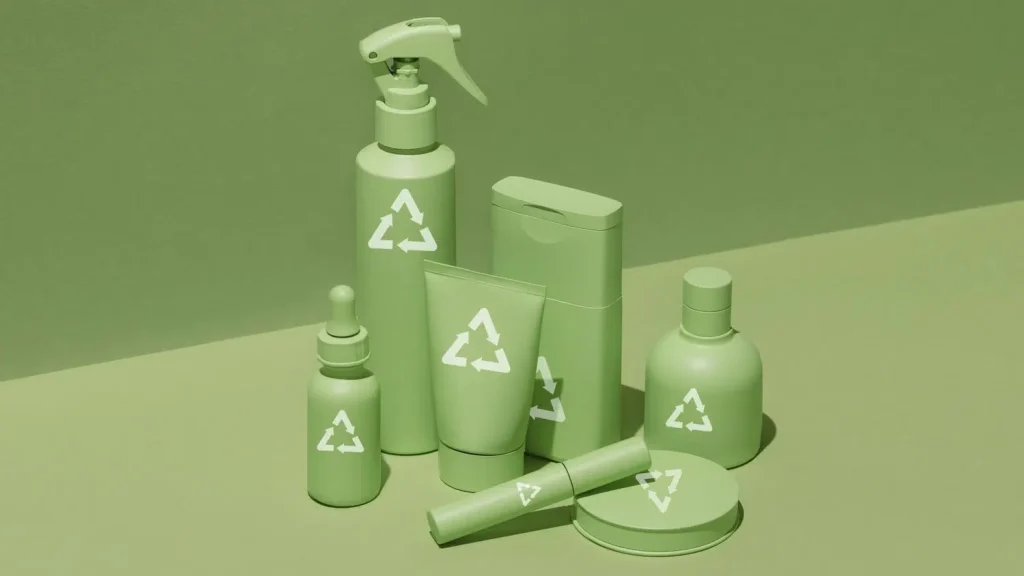
Recycled plastic packaging refers to packaging that contains a certain proportion of recycled plastic—specifically PCR (Post-Consumer Recycled resin). This material is derived from plastic waste collected from consumers, which is then sorted, washed, shredded, melted, and reprocessed into new plastic raw material for use in new packaging production.
Its core logic is not “avoid plastic,” but rather “put plastic into circulation rather than into a linear take-make-dispose pathway.” It acknowledges the necessity of plastic in today’s packaging landscape, while striving to reduce overall environmental load by extending the useful life of plastics and reducing the consumption of virgin materials.
From an eco friendly packaging perspective, the most significant contribution of recycled plastic packaging lies in reducing the demand for virgin plastic production. For every 1 ton of recycled plastic used, approximately 0.8 to 1.2 tons of crude oil consumption can be saved—depending on the material type and processing technology. Against the backdrop of increasingly strained fossil resources and fluctuating oil prices, this substitution carries resource-strategic significance in its own right.
When more packaging incorporates recycled materials, it means that an equivalent amount of waste is redirected back into the production system rather than being sent to landfills or incinerators. This aligns with the logic of recyclable packaging—but recycled plastic packaging goes one step further: it not only “can be recycled,” but also “already contains recycled content,” offering visible evidence of a closed-loop system in practice.
5. Reusable Packaging
Reusable packaging refers to packaging that is designed from the outset with the intention of multiple uses. After the consumer has finished the initial product, the packaging can be refilled, fitted with a new refill, or returned for replenishment—entering a new use cycle rather than being discarded after a single use.
Its core logic is not “what material is used,” but rather “making packaging last longer”—by extending the service life of the packaging to distribute the environmental burden across each use cycle.
From an eco friendly packaging perspective, increasing the number of uses is the most significant contribution of this packaging type. When a single piece of packaging is designed to be used five, ten, or even more times, the material consumption and carbon emissions associated with each unit of product are substantially diluted—regardless of whether the packaging is made of glass, plastic, or metal.
Every time packaging is reused, one fewer new package needs to be produced. This translates into reduced raw material extraction, resin production, injection or blow-molding energy consumption, and the associated carbon emissions throughout the manufacturing process.
6. Eco Friendly Packaging Solutions
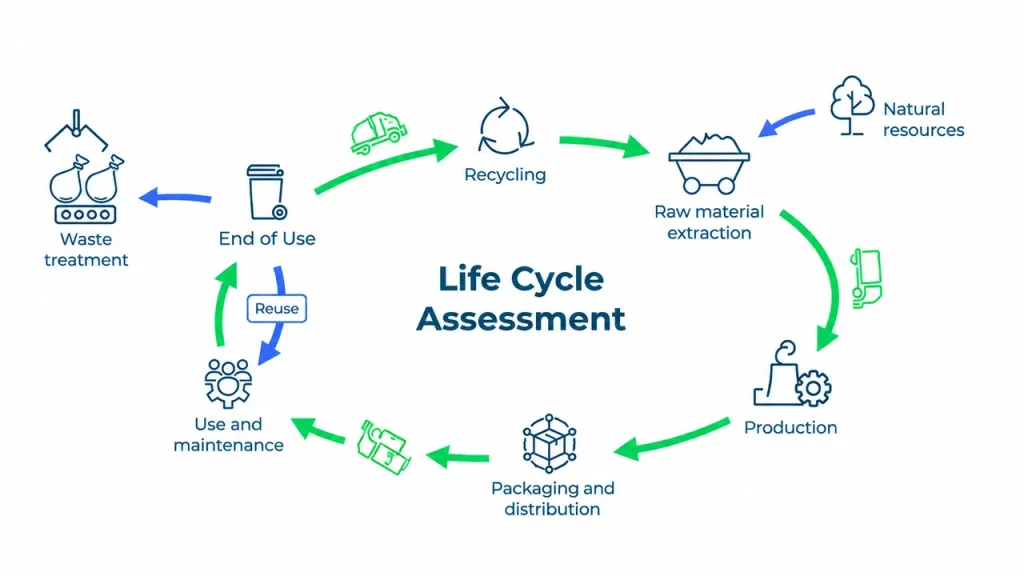
Eco friendly packaging is not an either-or label, but rather a proposition that requires continuous trade-offs across multiple dimensions—raw material sourcing, production energy consumption, usage efficiency, and end-of-life disposal. Whether bio-based, recyclable, recycled-content, or reusable, each direction offers optimization potential at a certain stage of the lifecycle, while also carrying its own practical limitations. This is the most authentic state of eco-friendly packaging today: there is no perfect answer—only better choices.
That said, this also means that the green transition of packaging does not have to wait for some “disruptive material” to emerge. On the contrary, many practical opportunities lie right within the material systems and process routes we are already familiar with—reducing material consumption through lightweighting, improving recyclability through mono-material design, reducing reliance on virgin resources by increasing recycled content, and extending packaging life through optimized usage models. These strategies do not require technological breakthroughs—they can be implemented immediately under current conditions.
The four pathways outlined above are intended to provide a directional reference framework, rather than an exclusive set of answers. We hope this article can spark more thinking about “how to make better packaging decisions under real production conditions”—whether you start with material selection, structural design optimization, or usage model reconfiguration. Every small step forward represents real progress toward a more eco-friendly direction.
As a manufacturer with years of experience in the cosmetic packaging industry, we have always believed that eco friendly packaging is not a fixed outcome, but an ongoing process of improvement. We are committed to exploring this process together with you—working within the framework of your specific product, brand positioning, usage scenarios, and cost expectations—to identify packaging solutions that are both feasible and improvement-driven.
If you are interested in any of the directions mentioned above, or would like to discuss an optimization assessment for your existing packaging, please feel free to reach out to us. Good packaging deserves thoughtful consideration—again and again.